One day in Alicante
4 stops, about 22 min of walking in total.
- Day 1: Seafront · Castle and Mount BenacantilPostiguet Beach → Santa Bárbara Castle → Barrio de Santa Cruz → Explanada de EspañaOpen in Google Maps
Spain
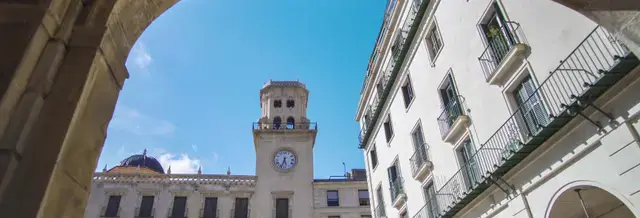
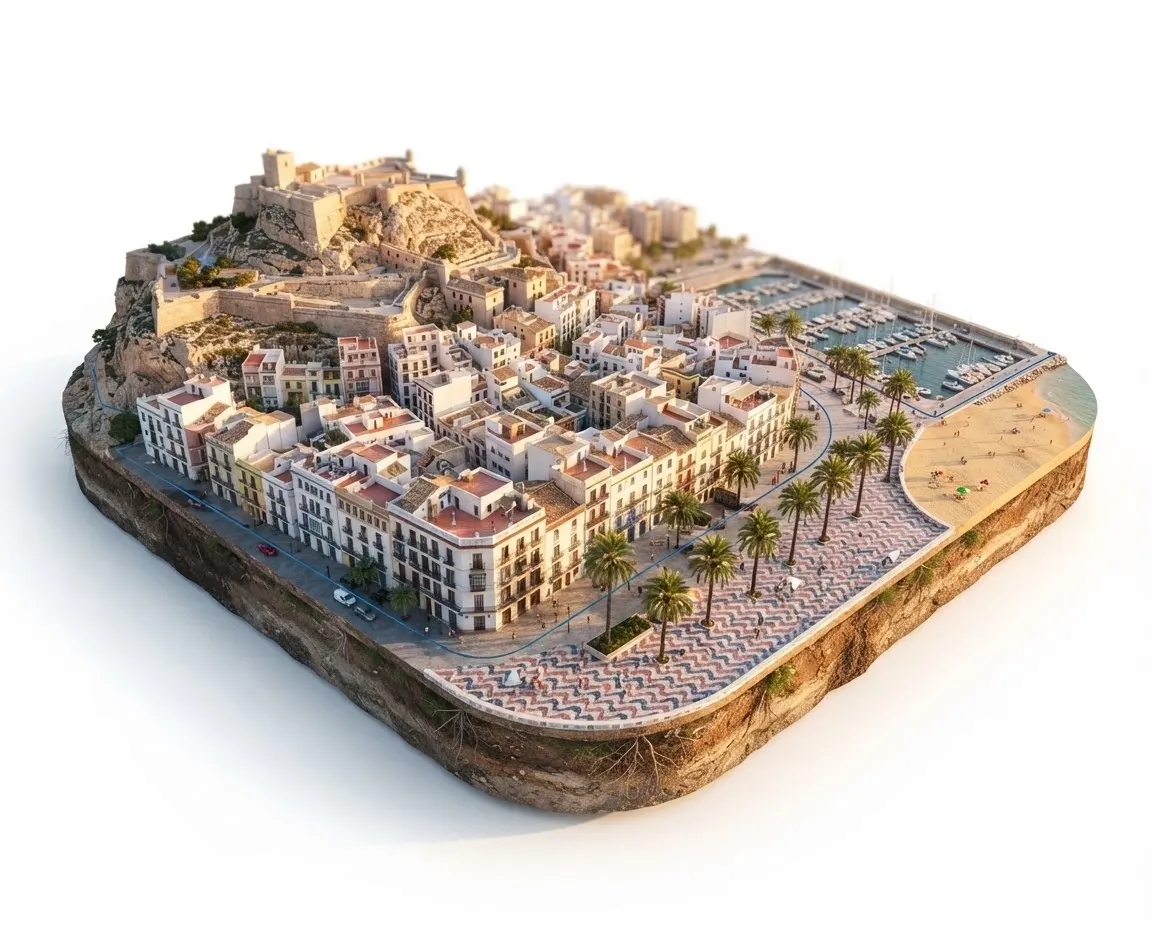
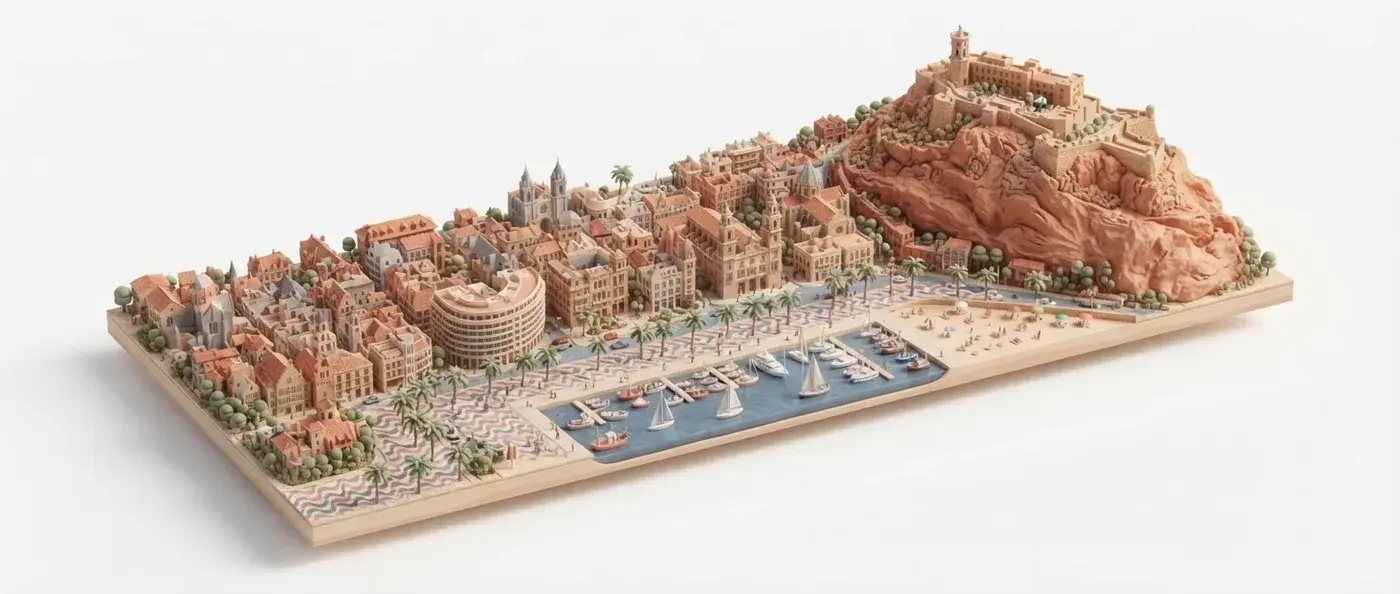
Alicante sits on the Mediterranean coast under the hill of Santa Bárbara Castle, with a marble promenade along the port and a city beach at the foot of the old town. Most of what a visitor wants is close together, and the castle, the churches and two good museums fill the days when the beach is not the plan. Rice, salted fish and nougat shape the table.
Data checked on November 13, 2026
Free walking tour
A guided walk gives you the layout of Alicante before you go off on your own. You book a place for free and tip the guide at the end.
See the free tourPartner link, opens in a new tab.
Each plan is built from the stop base, with visit time, the walk between stops and a lunch break. Open one and set your pace and arrival day.
4 stops, about 22 min of walking in total.
9 stops, about 51 min of walking in total.
14 stops, about 1 h 22 of walking in total.
April, May, June and October bring highs of about 22 to 28 degrees and between 1 and 4 rainy days a month. July and August are hot, with highs near 31 and lows near 22. Winter is mild, with highs near 17 or 18 degrees. June also holds the Hogueras de San Juan, from 20 to 24 June, when the city fills with fire monuments and fireworks.
Climate averages: Agencia Estatal de Meteorología.
12 to 22 °C · about 4 rainy days a month
Highs go from about 20 degrees in March to 25 in May, with 3 to 4 rainy days in March and April and fewer in May.
What to wear: Light layers and a jacket for the evening, with comfortable shoes for the castle hill.
21 to 30 °C · about 1 rainy days a month
Highs run from about 28 degrees in June to 31 in August, with nights around 18 to 22 degrees. July is the driest month, and the castle stays open until 23:00 from 17 June to 4 September.
What to wear: Light cotton, a hat, sunglasses, sandals and swimwear, plus sunscreen for the beach and the castle.
15 to 25 °C · about 4 rainy days a month
September is still hot, with highs near 28 degrees, then highs ease to 25 in October and 20 in November. October and November have the most rainy days of the year, at 4 each.
What to wear: Layers and a compact umbrella, with swimwear still useful in September.
7 to 18 °C · about 3 rainy days a month
Days are mild, with highs near 17 or 18 degrees and lows around 7. The castle closes at 18:00 from 15 November to 27 February.
What to wear: A medium jacket, a scarf for the evenings and a light waterproof layer.
Alicante has few rainy days, from 0.4 in July to 4.2 in October. When it rains, use MARQ, MACA, the Basilica of Santa María, the Co-Cathedral of San Nicolás and the Mercado Central. The Town Hall exhibition and MUBAG are also indoors, while the castle, the beaches and the parks are outdoors.
Stops under a roof
Highs reach about 31 degrees in July and August. Keep the beach and the castle walls for the morning or the evening, and in summer use the late castle hours, which run to 23:00. Shade is limited on the beaches and the Explanada, so carry water and sunscreen. Canalejas Park has old trees that give shade on the seafront.
Better outdoors
Per person, without the hotel. Tickets are the prices of the stops in each plan, read on the official sites. Food and transport come from the city figures.
| Plan | Tickets | Transport | Food | Total |
|---|---|---|---|---|
| 1 day | €0 | €6 | €42 to €54 | €48 to €60 |
| 2 days | €20 | €12 | €84 to €108 | €116 to €140 |
| 3 days | €23 | €18 | €126 to €162 | €167 to €203 |
Stops with a ticket whose price we could not confirm are left out of the sum.
Rice is the centre of local cooking, made with olive oil, saffron, tomato and fish or meat. Several restaurants carry the Alicante Ciudad del Arroz seal, which marks rice cooked with local products.
A winter stew of lentils, beans, rice, vegetables and pork ribs. Stews like this are most popular in winter.
A flat bread of flour, oil and water, here topped with tuna. Cocas are a staple of the Hogueras festival, and the coca de mollitas has a crunchy top.
Salt-cured tuna served with olive oil. It is one of the salted fish that markets and bars here still sell.
A handmade nougat of roasted almonds, egg white and honey. The Alicante and Jijona designation requires at least 60 percent almonds and 10 percent honey.
Wines with a protected designation of origin since 1932, with Moscatel among the whites and Monastrell among the reds.
From 20 to 24 June the city builds satirical monuments and burns them on the night of 24 June. Parades, fireworks and mascletàs fill the days, and the castle is closed on 24 June.
The processions are a festival of national tourist interest, with dates between March and May. One of the most heartfelt starts from the Ermita de Santa Cruz.
This promenade behind Postiguet beach has palm trees, bars and restaurants, and paving that creates a 3D effect. Walk it after the beach.
From 6 December to 6 January the city sets up a large nativity scene in the centre and holds the Three Kings parade. Nougat is the sweet of the season.
The open-air auditorium on the Explanada hosts concerts and cultural events through the year. Check the programme for dates.
Alicante-Elche airport is about 12 kilometres from the city, and the C6 bus links it with the centre every day, with stops at the train station, Avenida Alfonso el Sabio and Puerta del Mar. The train station is on Avenida de Salamanca and has high-speed AVE services from Madrid, and the bus station is on the Muelle de Poniente. Taxis also run from the airport.
The old town, the Explanada, Postiguet beach and the market can all be reached on foot. The castle has a lift, a minibus and a walking route, and a tram goes out to San Juan beach. A single bus ticket is 1.50 euros on the operator's page, which also lists multi-trip and monthly passes, so most visitors can pay by the ride.
Every stop has its own page with opening days, ticket price, how to get there and where it fits in the itineraries.
Castle and Mount Benacantil
A large medieval fortress on top of Mount Benacantil, with walks along the walls, courtyards and wide views of the city and the bay. Entry is free, and you can reach it by lift, minibus, taxi or on foot.
Seafront
A palm-lined promenade beside the port, paved in a wave pattern of tricolour marble. It is free and good for a slow walk, with an open-air auditorium for concerts.
Old town
The old quarter on the slope of Mount Benacantil, made of narrow, steep streets, whitewashed houses and flowerpots. It ends at a small hermitage and a lookout over the old town and the sea.
Castle and Mount Benacantil
The provincial archaeology museum, with galleries on prehistory, the Iberian and Roman worlds, the Middle Ages and the modern period. Many exhibits are interactive, which suits children.
Seafront
The city beach, at the foot of the castle and a few steps from the Explanada. It has golden sand, calm water and a promenade of bars and restaurants.
Old town
A late Renaissance church in the old town with a tall dome, a Baroque chapel and a 15th-century cloister. The cultural visit also climbs to the roof for views.
Old town
A church built in the 14th century on the site of the former great mosque. The ticket covers the chapels, the museum, the choir and the bell tower.
Old town
A museum of 20th-century art in the oldest civil building of the city, a 17th-century Baroque grain store. Its collections start from a donation by the Alicante artist Eusebio Sempere.
City centre
The covered market of the city, in a building from 1922 with Valencian Art Nouveau details. Fruit, fish, meat and a few places to eat sit under one roof.
Old town
A Baroque 18th-century building on the Plaza del Ayuntamiento, with the point from which heights above sea level are measured in Spain and a small archaeology exhibition underneath.
Lucentum and San Juan
The remains of the Iberian and Roman city that came before Alicante, on the Tossal de Manises outside the centre. Walls, streets, a forum and baths can be walked in the open air.
Old town
A fine arts museum in the 18th-century Gravina Palace in the old town, with a collection centred on 19th-century painting and sculpture.
Lucentum and San Juan
A long sandy beach on the north-east side of the city, with sports areas, summer beach bars and an avenue of restaurants behind it. It is the place for a full beach day.
Seafront
The oldest park in the city, shaded by ficus trees over a century old, beside the marina. It joins the Explanada and gives a quiet pause on the seafront.
Castle and Mount Benacantil
A hillside park on the slope of the castle, with a winding path and several lookouts over the city and the coast.
Wi-Fi in hotels, cafés and airports is shared with other guests. A VPN encrypts the connection between your phone or laptop and the VPN's server, which helps when you check email or your bank on the road.
See NordVPNOne day covers the castle, the old town, the Explanada and Postiguet beach, which sit close together in the centre. MARQ, the Lucentum site and San Juan beach are extra visits that need more time, so a short stay means choosing between the museums and the beach.
April, May, June and October have mild to warm weather, with highs of about 22 to 28 degrees. July and August are hot, with highs near 31 degrees.
Yes, entry to the castle is free. Only the lift from Avenida Juan Bautista Lafora has a ticket. From 15 November to 27 February the castle is open 10:00 to 18:00, and it closes on 24 June, 24, 25 and 31 December, and 1 and 6 January.
Use the indoor places: MARQ, MACA, the Basilica of Santa María, the Co-Cathedral of San Nicolás and the Mercado Central. Rain is rare, with at most 4.2 rainy days a month, in October.