One day in Segovia
3 stops, about 21 min of walking in total.
- Day 1: Jewish quarter and the Alcázar · Plaza Mayor and the cathedralAlcázar of Segovia → Segovia Cathedral → Roman aqueductOpen in Google Maps
Spain
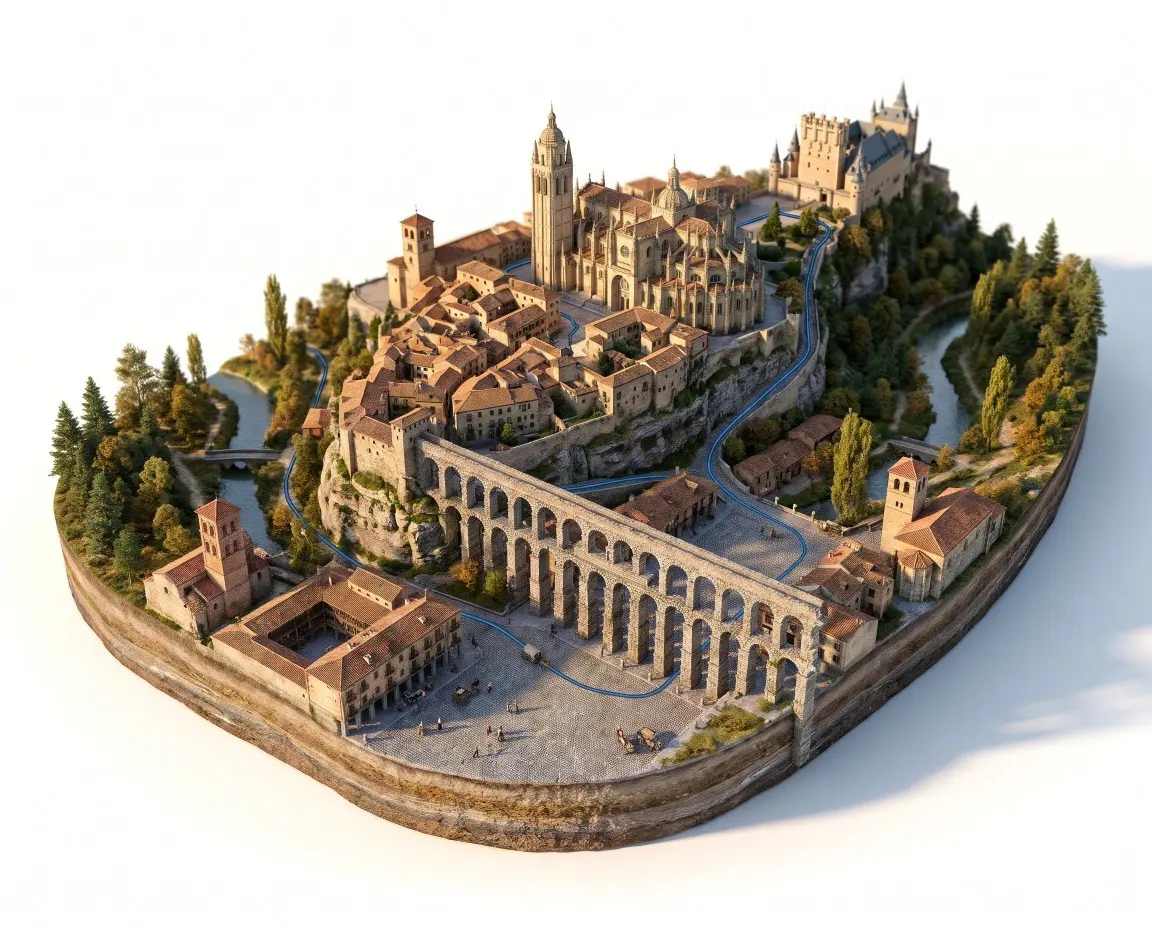
Segovia is a walled town on a rocky ridge at about 1,000 metres, with a Roman aqueduct at one end and the Alcázar at the other. The cathedral and Plaza Mayor sit between them, and the old Jewish quarter lies along the lanes in the west. The town is small enough to walk, so the day is shaped by opening hours rather than distance.
Data checked on November 2, 2026
Each plan is built from the stop base, with visit time, the walk between stops and a lunch break. Open one and set your pace and arrival day.
3 stops, about 21 min of walking in total.
7 stops, about 40 min of walking in total.
11 stops, about 1 h 09 of walking in total.
May, June and September are the best months, with afternoon highs of about 20 to 26 degrees. July and August reach about 29 to 30 degrees, but the town stands at around 1,000 metres and the nights are cool. From December to February highs stay at 8 to 10 degrees and lows are close to freezing.
Climate averages: Agencia Estatal de Meteorología.
5 to 16 °C · about 8 rainy days a month
Highs rise from about 14 degrees in March to 20 in May, and May is one of the rainiest months, with around ten rain days. The views are clear, but showers are common.
What to wear: Bring layers and a light waterproof, since mornings are cool and rain can come in May.
14 to 28 °C · about 4 rainy days a month
Highs reach 26 degrees in June and about 30 in July and August, with only three to five rain days a month. Nights fall to 12 to 15 degrees.
What to wear: Wear light clothes, a hat and comfortable shoes for the cobbles, and bring a light layer for the evening.
8 to 18 °C · about 8 rainy days a month
September is still warm, near 24 degrees, while October falls to about 18 and November to about 12. October and November have around nine rain days each.
What to wear: Bring a jacket and something waterproof, and shoes that grip on wet stone.
1 to 9 °C · about 7 rainy days a month
Highs are about 8 to 10 degrees and lows are close to freezing, with seven or eight rain days a month. Monuments close early, between 18:00 and 18:30.
What to wear: Wear a warm coat, a scarf, gloves and shoes with grip.
Rain is most frequent in May, October and November, with nine or ten rain days a month. The Alcázar, the cathedral, the Casa de Moneda, the Machado house and the churches are indoors, so a wet day is easy to fill. Keep the aqueduct and the valley for a dry spell, since the paths are slippery.
Stops under a roof
Summer afternoons reach about 30 degrees, and the aqueduct square and the Pradera have little shade. Keep outdoor walks for the morning and the evening, and use the cathedral, the Alcázar and the museums as cool breaks at midday. Carry water.
Better outdoors
Per person, without the hotel. Tickets are the prices of the stops in each plan, read on the official sites. Food and transport come from the city figures.
| Plan | Tickets | Transport | Food | Total |
|---|---|---|---|---|
| 1 day | €11 | €4.60 | €32 to €40 | €47 to €55 |
| 2 days | €15 | €9.20 | €64 to €79 | €88 to €104 |
| 3 days | €22 | €13.80 | €95 to €119 | €131 to €155 |
Roast suckling pig, the best-known dish of Segovia. It is traditionally served at lunch in the old town restaurants.
Large white beans stewed with pork, a warming dish for cold days. It appears on most winter menus.
A Castilian soup of garlic, bread, paprika and egg, served hot in a clay dish.
A local cake of sponge, custard and marzipan, topped with sugar. Buy a slice in the pastry shops around Plaza Mayor.
Crisp fried pork belly, served as a tapa with a drink.
Roast lamb, cooked in a wood oven, a classic of Castile that is common on restaurant menus.
A path runs from the Pradera de San Marcos along the river, past the Vera Cruz church and the Casa de Moneda, with views of the walls and the Alcázar.
After the monuments close, the arches and the square are quiet, and the stone takes on warm colours before sunset.
The tower can be visited on a guided visit, with several times a day, and there is also a night visit.
The tourist office runs guided walks with official guides, including one on the World Heritage site every day at 11:30 from October to Easter.
A table under the arcades is a good place to rest between monuments and watch the square.
Madrid is the usual way in, with high-speed trains to Segovia-Guiomar station and coaches to the bus station, so check the operators for timetables. Guiomar station is outside the old town; check the city bus operator for the link to the centre.
The old town is best on foot. City buses run through the town, and a single ticket costs 1.15 euros, with no day pass listed. The valley stops below the Alcázar are the longest walk, with a climb on the way back.
Every stop has its own page with opening days, ticket price, how to get there and where it fits in the itineraries.
Aqueduct and Plaza de San Martín
The Roman aqueduct that crosses Plaza del Azoguejo on two tiers of granite arches. It stands in the open, so it has no hours and no ticket.
Jewish quarter and the Alcázar
The royal fortress at the western tip of the old town, with the palace rooms, a museum and the Torre de Juan II. Visitors choose the palace and museum, or add the tower.
Booking advisedPlaza Mayor and the cathedral
The cathedral on Plaza Mayor, a 16th century building known as the Lady of the Cathedrals for its size. The ticket also covers the Palacio Episcopal.
Plaza Mayor and the cathedral
The main square of the old town, with the cathedral on one side and arcaded cafés around it. It is the natural place to stop between monuments.
Jewish quarter and the Alcázar
A walk through the narrow lanes of the former Jewish quarter, between the cathedral and the walls at the Puerta de San Andrés. The streets are open at all times.
Eresma valley
A small twelve-sided Romanesque church outside the walls, in the care of the Order of Malta. It stands in the valley below the Alcázar.
Eresma valley
The former royal mint beside the Eresma river, now a museum. The ticket also covers the Aqueduct Interpretation Centre and the Jardín del Rey.
Plaza Mayor and the cathedral
A small church that was the main synagogue of the Jewish quarter. It opens on fewer days than most sights, so check the calendar.
Jewish quarter and the Alcázar
A medieval gate in the town walls, now an information space about the walls. It is open in the morning only.
Eresma valley
The meadow below the Alcázar where you see the castle from the side, over the Eresma valley. It is a stop for photos and a long look.
Aqueduct and Plaza de San Martín
A Romanesque church with an arcaded gallery, on Plaza de Medina del Campo. Opening hours depend on services, so it is best seen from outside.
Plaza Mayor and the cathedral
The house where the poet Antonio Machado lodged while he lived in Segovia, kept as a small museum.
Aqueduct and Plaza de San Martín
A tower house on Plaza de San Martín that works as a cultural centre, with a museum and temporary exhibitions.
Eresma valley
The Discalced Carmelite convent that holds the tomb of the poet and saint John of the Cross. The visit is short and quiet.
Eresma valley
The sanctuary of the patron of Segovia, set by the Eresma below the walls. It is open all day and is a quiet stop on the valley walk.
Wi-Fi in hotels, cafés and airports is shared with other guests. A VPN encrypts the connection between your phone or laptop and the VPN's server, which helps when you check email or your bank on the road.
See NordVPNOne day covers the aqueduct, Plaza Mayor, the cathedral and the Alcázar if you start at opening time and walk between them. The valley below the Alcázar, the churches and the museums need a second half-day, and most monuments close between 18:00 and 18:30 in winter.
The Alcázar strongly recommends buying tickets ahead, because they often sell out on weekends and holidays, especially with the Torre de Juan II. The cathedral and the other sights sell tickets on the day.
Yes, the old town is small and the sights are close together, but the lanes are hilly. A single city bus ticket costs 1.15 euros, and no day pass is listed.
May, June and September bring afternoon highs of about 20 to 26 degrees. July and August reach about 29 to 30 degrees, and winter days stay at 8 to 12 degrees with nights near freezing.