One day in Vienna
5 stops, about 20 min of walking in total.
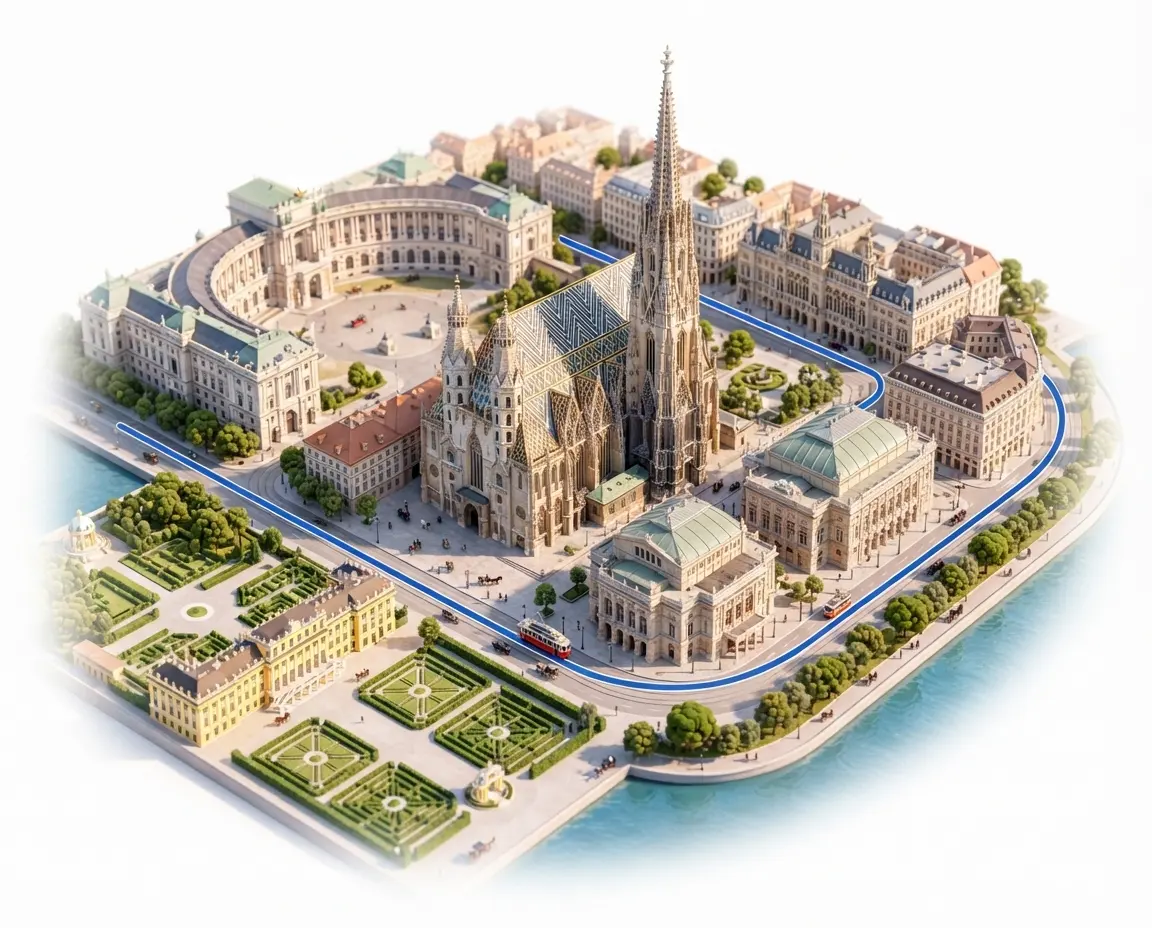
- Day 1: Inner City · RingstrasseHofburg Imperial Apartments and Sisi Museum → Vienna State Opera → St. Stephen's Cathedral → Upper Belvedere → Wiener RiesenradOpen in Google Maps
Austria
Vienna keeps its main sights in two zones: a compact Inner City inside the Ringstrasse and a ring of palaces and museums just outside it. The big collections are large enough to fill half a day each, and the coffee houses are part of the plan rather than a break from it. Most of the centre is walkable, and the U-Bahn covers the rest.
Data checked on October 5, 2026
Each plan is built from the stop base, with visit time, the walk between stops and a lunch break. Open one and set your pace and arrival day.
5 stops, about 20 min of walking in total.
8 stops, about 1 h 01 of walking in total.
12 stops, about 1 h 33 of walking in total.
April, May, September and October give the best mix of mild weather and manageable queues. July and August are warm and busy at the palaces, and December fills up with visitors for the Christmas markets. January and February are cold and grey, which suits museums and coffee houses better than long walks.
Climate averages: GeoSphere Austria.
8 to 16 °C · about 8 rainy days a month
March is still cool with highs around 11 degrees, April reaches about 17 and May about 21. May is the wettest of the spring months, with showers that pass. The park lawns and the Schönbrunn gardens turn green.
What to wear: Pack layers, a light waterproof jacket and comfortable shoes for cobbles.
17 to 27 °C · about 9 rainy days a month
Highs reach 26 to 27 degrees in July and August with warm evenings, and the Danube Canal bank fills with people. Summer is the busiest time at Schönbrunn and the Ferris wheel.
What to wear: Wear light clothes, a hat and sunscreen by day, and bring a thin layer for cool church interiors.
9 to 16 °C · about 7 rainy days a month
September is pleasant at about 22 degrees and October drops to about 15, with shorter days. Queues ease once school holidays end, and the leaves turn in the parks.
What to wear: Bring a warm layer and a rain jacket, and closed shoes from October.
1 to 5 °C · about 7 rainy days a month
Highs sit around 4 to 5 degrees and nights are near freezing, with short daylight. In December the Christmas markets draw large crowds, especially in the evenings.
What to wear: Wear a warm coat, hat and gloves, and shoes with grip for wet cobbles. Indoors is well heated, so dress in layers.
Rain is spread across the year, with May to August the wettest months, so keep an indoor plan for each day. The Kunsthistorisches Museum, the Albertina, the Belvedere and the Natural History Museum can each fill half a day, and a coffee house is the standard way to wait out a shower. The Ferris wheel and the Schönbrunn gardens lose most of their appeal in low cloud.
Stops under a roof
July and August afternoons reach about 27 degrees, which is warm rather than punishing. The Ringstrasse, the Schönbrunn park and the Naschmarkt have little shade at midday, so do them in the morning or evening. Spend the hottest hours in a museum or a cool church, and carry water, since the tap water is safe to drink.
Better outdoors
Per person, without the hotel. Tickets are the prices of the stops in each plan, read on the official sites. Food and transport come from the city figures.
| Plan | Tickets | Transport | Food | Total |
|---|---|---|---|---|
| 1 day | €69 | €10.20 | €37 to €60 | €116 to €139 |
| 2 days | €115 | €20.40 | €73 to €120 | €209 to €256 |
| 3 days | €163.40 | €30.60 | €110 to €180 | €304 to €374 |
Stops with a ticket whose price we could not confirm are left out of the sum.
A thin veal cutlet in breadcrumbs, fried and served with potato salad and a lemon slice. It is the standard lunch order at a traditional restaurant.
Boiled beef served in its broth, with apple horseradish and chive sauce. It is a classic Sunday lunch dish.
A sausage filled with cheese, eaten at a street stand with bread and mustard. It is the usual snack after a night out.
Thin pastry rolled round spiced apples and raisins, served warm with vanilla sauce or cream. It appears on every coffee house menu.
A dense chocolate cake with a layer of apricot jam, served with unsweetened whipped cream. It goes with a coffee in the afternoon.
The local milk coffee, made with espresso and steamed milk and close to a cappuccino. It comes with a glass of water and can be nursed for an hour.
Traditional coffee houses are made for sitting, with newspapers on wooden holders and no pressure to leave. Order a coffee and a cake and stay as long as you like.
Wine taverns on the edge of the city serve the year's wine with a cold buffet, often in a garden. Villages such as Grinzing and Nussdorf are reached by tram or bus.
Standing places for evening performances are sold shortly before the show. It is a low cost way to hear a performance in the house.
The canal path on the edge of the Inner City is lined with bars and street art, and it fills on warm evenings. Walk or cycle it from Schwedenplatz.
A bus from the north of the city climbs to a lookout over Vienna and the Danube, with vineyards and Vienna Woods paths nearby. It is a good clear day extra.
From Vienna Airport, the S7 S-Bahn and regional trains reach Wien Mitte in about 25 minutes, and long distance trains reach the Hauptbahnhof in about 15 minutes. Airport buses also serve the centre. The airport lies outside the core zone, so the airport leg needs an additional ticket. Wien Mitte connects to the U3 and U4 lines, and the Hauptbahnhof to the U1 line and trams.
The U-Bahn, trams and buses share one fare system, and every stop here lies in the core zone. The Inner City is walkable, with the cathedral, the Hofburg and the Albertina within about ten minutes of each other. Schönbrunn, the Belvedere and the Prater are easier by U-Bahn or tram, and a 24 hour pass pays off from about four rides.
Every stop has its own page with opening days, ticket price, how to get there and where it fits in the itineraries.
Inner City
The Gothic cathedral at the centre of the Inner City, with a patterned tile roof and a tall south tower. The interior, the two towers and the catacombs each have their own admission and times.
Schönbrunn
The Habsburg summer palace on the western edge of the city, with state rooms, private apartments and a large park. The palace tour is timed and takes about an hour and a quarter, and the park is free to walk.
Book aheadInner City
The Habsburg winter residence in the Inner City. One ticket covers the Sisi Museum and the Imperial Apartments, and the visit takes about an hour.
Booking advisedBelvedere and Landstrasse
A Baroque palace with Austrian art from the Middle Ages to the present, including the best known works of Klimt. The gardens between the Upper and Lower Belvedere are free to walk.
Booking advisedMuseum quarter
The Habsburg art collection in a 19th century museum on Maria-Theresien-Platz. From 8 September 2026 entry is by reserved time slot only.
Book aheadInner City
A museum in a Habsburg palace at the end of the Hofburg, with the state rooms, a large collection of prints and drawings and modern art. The Albertina Modern is a separate building about ten minutes away.
Ringstrasse
The opera house on the Ringstrasse, visited on a guided tour of about 40 minutes. Tour dates change every month and are published in the middle of the month before.
Book aheadKarlsplatz and Naschmarkt
A Baroque church on Karlsplatz with a green dome and two tall columns in front. The visit includes the church model, the treasury, the organ and a panoramic terrace.
Prater
The giant Ferris wheel in the Prater, in service since 1897. A turn takes about 12 to 15 minutes, and a Panorama Museum on Prater history is included.
Karlsplatz and Naschmarkt
The long market between Karlsplatz and Kettenbrückengasse, with produce, spice and food stalls and a row of small restaurants. On Saturdays there is a flea market at the far end.
Ringstrasse
The 5.3 kilometre boulevard around the Inner City, lined with the opera, the parliament, the city hall, the university and two museums. It is a walk or a tram ride, with no admission and no hours.
Museum quarter
A museum of Austrian modern art in the MuseumsQuartier, with a large Egon Schiele collection and works by Klimt and Kokoschka. It is closed on Tuesdays.
Museum quarter
The museum opposite the Kunsthistorisches Museum, with minerals, dinosaurs, meteorites and prehistory. It is a good rain day choice for families and closed on Tuesdays.
Belvedere and Landstrasse
A residential building from the 1980s with a colourful, uneven facade and trees on the balconies. It can only be viewed from outside, and the Hundertwasser Village opposite is open to visitors.
Ringstrasse
The oldest public park in the city, beside the Ringstrasse, with lawns, a pond and the gilded Johann Strauss monument. It is a short green stop between the Inner City and the Belvedere.
One day covers the Inner City: the cathedral, the Hofburg and one museum, with an evening walk on the Ringstrasse. The palaces and the big museums each take half a day, so with one day you have to choose. Book timed tickets first and fit the walking sights around them.
The Kunsthistorisches Museum uses reserved time slots from 8 September 2026, and Schönbrunn and the Hofburg sell timed tickets online. The Belvedere lets online ticket holders go straight in. The State Opera sells its guided tours by date, so book the date that suits you.
The Leopold Museum and the Natural History Museum close on Tuesdays, and the Naschmarkt is closed on Sundays. The Hofburg changes its hours from 6 October to 18 November 2026, so check the official page before you go.
A 24 hour pass pays off from about four rides, which is an ordinary day with Schönbrunn, the Belvedere and the Prater. If you stay in the Inner City and walk, single tickets are enough.