One day in Athens
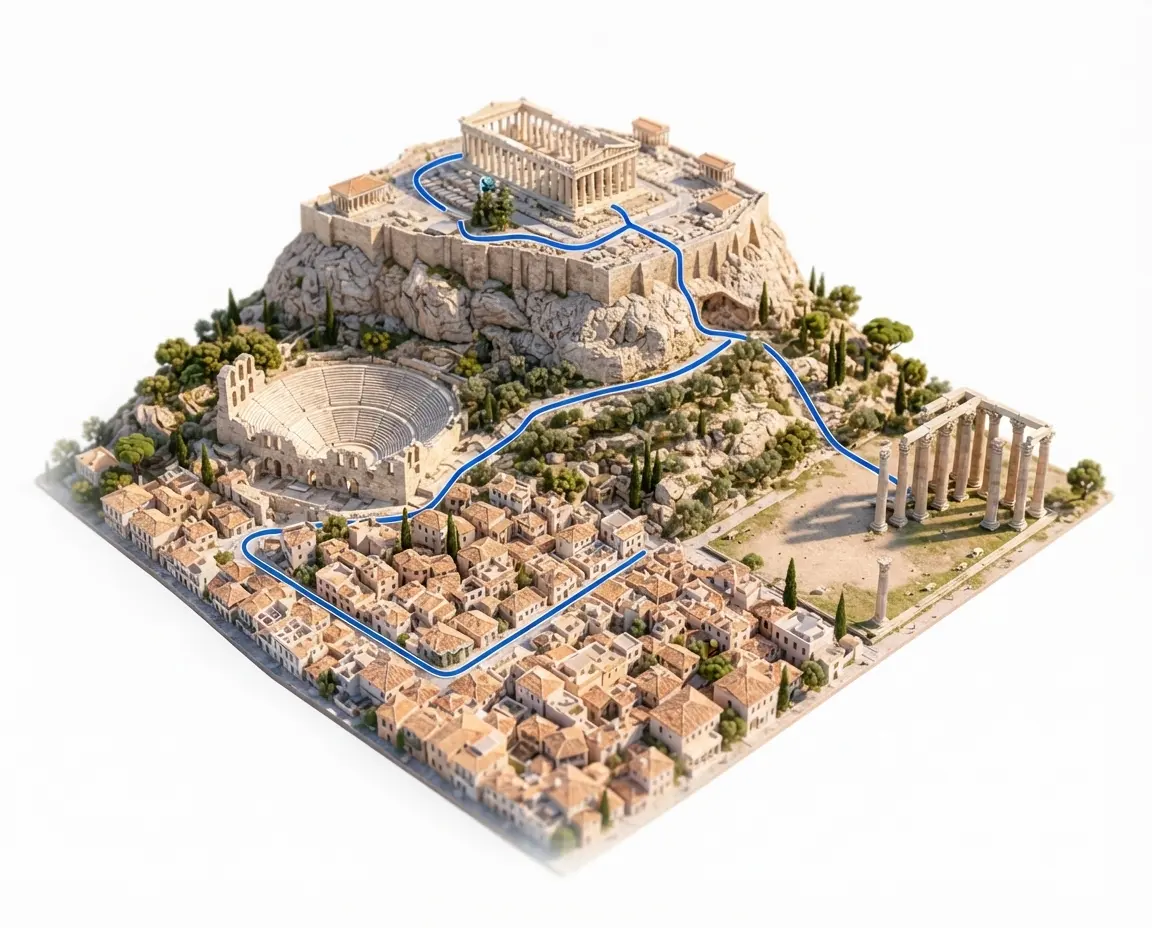
4 stops, about 40 min of walking in total.
- Day 1: Acropolis and Makrygianni · Syntagma and KolonakiAcropolis → Acropolis Museum → Temple of Olympian Zeus → Lycabettus HillOpen in Google Maps
Greece
Athens keeps its ancient sites inside a modern city, so the Acropolis, the Agora and the old Roman market all stand among shops, cafes and apartment blocks. The centre is small enough to cover on foot and by metro. Plaka and Monastiraki fill the gaps between the sites, and the hills give the best views.
Data checked on October 5, 2026
Each plan is built from the stop base, with visit time, the walk between stops and a lunch break. Open one and set your pace and arrival day.
4 stops, about 40 min of walking in total.
10 stops, about 1 h 50 of walking in total.
13 stops, about 2 h 07 of walking in total.
April, May, September and October work best: warm enough for the sites, with moderate crowds and manageable heat. June to August brings the biggest crowds and highs around 30 degrees or more, so the Acropolis is best at opening. From December to February the city is cool and wet but quiet, and the sites close earlier.
Climate averages: Hellenic National Meteorological Service.
12 to 20 °C · about 9 rainy days a month
March is cool and showery with highs near 16 degrees. By April highs reach about 20, by May 24, and rain falls on about six days a month, which makes this the best season for the sites.
What to wear: Bring light layers, a rain jacket for March and early April, and shoes with grip for polished marble.
22 to 31 °C · about 3 rainy days a month
Highs average about 29 degrees in June and 32 in July and August, with little rain, and the centre feels hotter than the coast. The sites are crowded and hot from mid morning.
What to wear: Wear light loose clothes, a hat, sunglasses and sunscreen, and shoes with a firm sole for slippery stone.
16 to 23 °C · about 8 rainy days a month
September is still hot at about 28 degrees, October eases to 23 and November to 19, with rain returning on about 11 days in November. Crowds thin out from October.
What to wear: Pack layers and a light rain jacket for October and November.
8 to 14 °C · about 13 rainy days a month
Highs sit at about 14 or 15 degrees and nights fall to about 7, with rain on 11 to 14 days a month. The sites are quiet but several close early in the afternoon.
What to wear: Wear a warm waterproof jacket and shoes that keep out water.
Rain falls on 11 to 14 days a month from December to March, usually in showers, and the marble on the Acropolis and the hills becomes slippery. A wet day suits the Acropolis Museum, the National Archaeological Museum and the covered Central Market, which is closed on Sundays. If a shower is short, shelter in a museum and go back to the rock afterwards.
Stops under a roof
From June to August the open sites are hot from late morning and the Acropolis has almost no shade. Go at opening, spend the middle of the day in the museums or in the shade of the National Garden, and go back to the hills for sunset. The Ministry's site rules ban eating and drinking inside archaeological sites, so plan your drinks for before and after.
Better outdoors
Per person, without the hotel. Tickets are the prices of the stops in each plan, read on the official sites. Food and transport come from the city figures.
| Plan | Tickets | Transport | Food | Total |
|---|---|---|---|---|
| 1 day | €70 | €4.10 | €34 to €52 | €108 to €126 |
| 2 days | €102 | €8.20 | €67 to €105 | €178 to €215 |
| 3 days | €132 | €12.30 | €101 to €157 | €245 to €301 |
Grilled meat on a skewer or off a spit, served in a pita or on a plate. It is the standard quick meal in the centre.
The village salad of tomato, cucumber, onion, olives and a slab of feta, dressed with olive oil and oregano.
Spinach and cheese pies in filo pastry, sold warm from bakeries and eaten for breakfast or a snack.
Small fried dough balls soaked in honey and dusted with cinnamon, eaten warm as a dessert or an afternoon treat.
A shaken iced espresso that Athenians drink all year, often with a layer of cold foam on top.
A table of small dishes shared with a glass of aniseed ouzo or grape tsipouro, usually in the late afternoon or evening.
The pedestrian avenue below the Acropolis runs from the museum to Thissio, and it is quiet and cool after sunset.
In summer, screenings run outdoors under the sky, often with a view of the Acropolis, and they start after dark.
The coast south of the city is about 30 minutes away, with beaches, marinas and seafront walks.
The streets north of Monastiraki fill with small tavernas and music at night, and it is a good place to try several dishes.
A short sailing from the port reaches a Saronic island for a half day by the water.
Metro line 3 runs from Athens International Airport to Syntagma in about 40 minutes, and the X95 express bus to Syntagma takes about an hour in traffic. The city's transport operator lists the airport metro ticket at 9 euros and the express bus ticket at 5.50 euros, each one way. Trains from the north arrive at Larissa Station on Metro line 2, and ferries arrive at Piraeus, where Metro line 1 runs to Monastiraki.
The centre is compact: the Acropolis, Plaka, Monastiraki and Syntagma sit within about a 20 minute walk of each other. The metro is the quickest way to cover longer hops, with lines 2 and 3 crossing at Syntagma and line 1 serving Monastiraki and Thissio. The 24 hour ticket pays off from the fourth ride in a day, and a single ticket is valid for 90 minutes on buses, trams and the metro.
Every stop has its own page with opening days, ticket price, how to get there and where it fits in the itineraries.
Acropolis and Makrygianni
The sacred rock with the Parthenon, the Propylaia, the Erechtheion and the temple of Athena Nike. The visit is a climb up a stone path and a loop of the summit, with almost no shade.
Booking advisedAcropolis and Makrygianni
The museum at the foot of the rock holds the finds from the Acropolis, with the Parthenon sculptures on the top floor. Glass floors let you look down onto an excavated neighbourhood under the building.
Booking advisedThissio and Kerameikos
The marketplace and civic centre of classical Athens, with the best preserved Doric temple in Greece and a reconstructed stoa that houses a museum. The ticket covers the site and the museum.
Plaka and Monastiraki
The old neighbourhood under the north slope of the Acropolis, with pedestrian lanes, neoclassical houses and small churches. It is free and open at all hours, and shops and cafes keep their own times.
Exarchia and Patission
The largest archaeological museum in Greece and one of the main museums in the world for ancient Greek art. The collections run from prehistory to late antiquity.
Acropolis and Makrygianni
The remaining columns of the largest temple in ancient Athens, standing in an open site beside Hadrian's Arch. The Roman emperor Hadrian finished the temple in the second century.
Syntagma and Kolonaki
The marble stadium that hosted the first modern Olympic Games in 1896. You can walk the stands and the track, and the ticket includes an audio guide and the stadium museum.
Plaka and Monastiraki
The busy square at the foot of the Acropolis where the metro, the flea market lanes and an Ottoman mosque meet. It is free and open at all hours.
Syntagma and Kolonaki
The highest hill in central Athens, with a small chapel at the top and a view across the city to the sea. A path climbs from Kolonaki, and a funicular runs most of the way up.
Syntagma and Kolonaki
The main square of modern Athens, in front of the Greek Parliament, with the Tomb of the Unknown Soldier and a guard change every hour. It is free and open at all hours.
Syntagma and Kolonaki
A shaded public garden behind the Parliament, with over 500 plant species, a small zoo and a botanical museum. It is free to enter.
Plaka and Monastiraki
The marketplace built under Julius Caesar and Augustus, with the Gate of Athena Archegetis and the octagonal Tower of the Winds. The site is small and usually quiet.
Thissio and Kerameikos
A pine-covered hill southwest of the Acropolis, topped by a Roman monument, with one of the best views of the Acropolis. It is free and open at all hours.
Thissio and Kerameikos
The ancient cemetery of Athens, with a stretch of the city wall, rows of grave monuments and a small museum. It is rarely crowded.
Plaka and Monastiraki
The main covered food market of Athens, with a fish hall, a meat hall and spice and cheese shops on the streets around. It is closed on Sundays.
One day covers the Acropolis, the Acropolis Museum and the lanes of Plaka and Monastiraki if you start at opening. You will miss the Ancient Agora, the National Archaeological Museum and the hill views. Keep the Acropolis for the morning, when it is coolest and quietest.
You can buy tickets at the gate, but the queue builds from mid morning. Booking on the Ministry of Culture e-ticketing service and arriving at opening is the safest plan. The Acropolis Museum is a separate ticket.
The Acropolis Museum closes at 17:00 on Mondays, and the National Archaeological Museum opens only at 13:00 on Tuesdays. The Central Market is closed on Sundays. State sites close on 1 January, 25 March, 1 May, Easter Sunday and 25 and 26 December.
July and August highs average about 32 degrees and the centre feels hotter. It is manageable if you visit the open sites at opening, spend the middle of the day in museums, and return to the hills at sunset.