
One day in Lisbon
5 stops, about 43 min of walking in total.
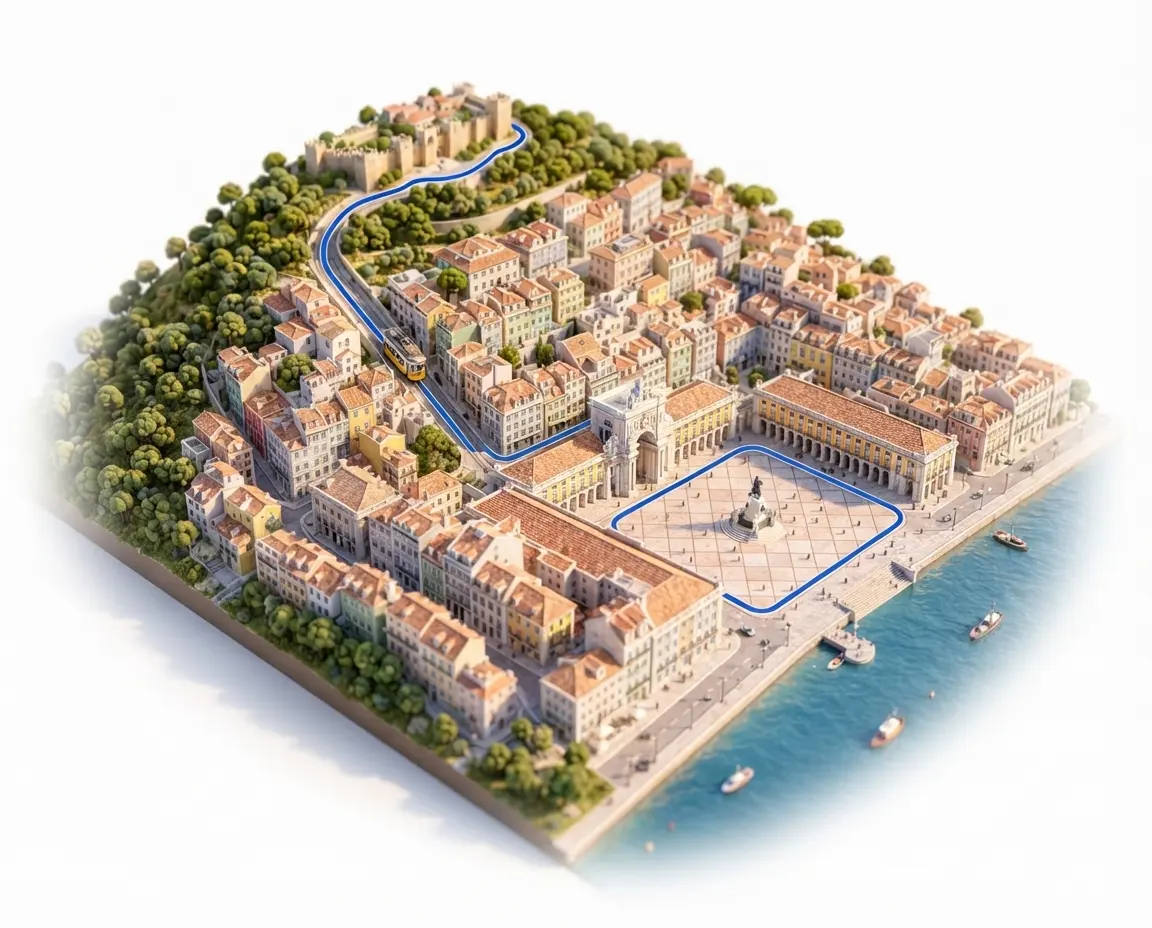
- Day 1: Belém · Castle, Alfama and GraçaBelém Tower → Jerónimos Monastery → São Jorge Castle → Praça do Comércio → Time Out Market LisboaOpen in Google Maps
Portugal
Lisbon is built on steep hills above the Tagus. The old centre is compact, but the sights are spread across four zones: the castle and Alfama, Baixa and Chiado, Belém by the river, and the modern east side. Trams, funiculars and the metro link them, and you will still climb a lot.
Data checked on October 4, 2026
Free walking tour
A guided walk gives you the layout of Lisbon before you go off on your own. You book a place for free and tip the guide at the end.
See the free tourTickets and tours you book online with a booking partner, each with a photo from the partner.
Partner link, opens in a new tab.
Each plan is built from the stop base, with visit time, the walk between stops and a lunch break. Open one and set your pace and arrival day.
5 stops, about 43 min of walking in total.
10 stops, about 1 h 19 of walking in total.
13 stops, about 1 h 24 of walking in total.
April, May, June and October give the best mix of weather and space. Daytime highs stay between 20 and 26 degrees, and rain days fall from about eight in April to two in June. July, August and September are the busiest and hottest, with the most queues at Belém and the castle. From November to March days are cooler and wetter, but the sights are quiet and the light is good.
Climate averages: Instituto Português do Mar e da Atmosfera, period 1991 to 2020.
13 to 21 °C · about 7 rainy days a month
Highs reach about 19 degrees in March and 23 in May. Rain falls on 6 to 8 days a month, and it is often short. Crowds build through the season.
What to wear: Pack layers, a light waterproof jacket and shoes with grip for wet cobbles.
18 to 28 °C · about 1 rainy days a month
July and August average a high near 28 degrees, with very little rain and many dry, sunny days. The old centre fills with visitors, and the hills feel hotter than the thermometer says.
What to wear: Wear light cotton, a hat and sunscreen, and carry a refillable bottle.
15 to 23 °C · about 7 rainy days a month
September is still warm, around 27 degrees, and rain returns in October and November, to about 9 to 10 days a month. The queues thin out in October.
What to wear: Pack a mix of light layers and a rain jacket, plus shoes that dry fast.
9 to 16 °C · about 9 rainy days a month
Highs sit around 15 or 16 degrees and lows near 9, and December and January have about 10 days of rain each. The city rarely gets cold, but wet days are common, and queues are short.
What to wear: Bring a warm jacket, a waterproof layer and shoes with a non-slip sole.
Rain makes the cobbled lanes of Alfama and Bairro Alto slippery, and trams run slowly. Indoor choices still fill a day well: the Gulbenkian Museum, the Oceanário, the Jerónimos Monastery, the National Pantheon and the cathedral. Time Out Market works for a long lunch, and the Carmo ruins are half open to the sky, so keep them for a dry break.
Stops under a roof
On summer afternoons the castle, Praça do Comércio and the Belém waterfront have almost no shade. In an average August the high passes 30 degrees on about 10 days, so start outdoor sights early. Spend the hottest hours, roughly 13:00 to 17:00, in a museum or a long lunch, then return to the viewpoints in the evening.
Better outdoors
Per person, without the hotel. Tickets are the prices of the stops in each plan, read on the official sites. Food and transport come from the city figures.
| Plan | Tickets | Transport | Food | Total |
|---|---|---|---|---|
| 1 day | €50 | €7.25 | €33 to €48 | €90 to €105 |
| 2 days | €74 | €14.50 | €65 to €96 | €154 to €184 |
| 3 days | €119.90 | €21.75 | €98 to €144 | €240 to €285 |
A small egg custard tart in flaky pastry, eaten warm with cinnamon. People have one with a coffee at any time of day.
Salted cod, cooked in hundreds of ways, often with potatoes and egg. It is the dish most Lisbon restaurants are known for.
Grilled sardines on bread, a summer staple that peaks around the June festivals in the old quarters.
A pork cutlet cooked in garlic and wine and served in a roll. It is a quick, cheap lunch at a counter.
A sour cherry liqueur served in a small glass, sometimes in a chocolate cup. Locals take it standing at a street hatch.
A wet rice dish with shellfish, served in a pot for sharing. Order it for a long, slow dinner.
The line climbs through Graça, Alfama and Baixa. Ride it before 09:00 or after 19:00 to avoid the queue at the first stop.
Small venues in Alfama and Mouraria hold fado after dinner. The singing stops for silence, so keep conversation low.
A short boat ride across the Tagus from Cais do Sodré, with a wide view back at the city and a walk along the south bank.
A flea market on the Campo de Santa Clara, next to the Pantheon, held on Tuesdays and Saturdays. Come in the morning for a better pick.
The CP line from Cais do Sodré follows the river and then the coast, with beaches and a seafront promenade at the end.
From the airport the Red Metro line reaches the centre in roughly 25 to 35 minutes with one change. Airport buses and taxis take 15 to 30 minutes, depending on traffic. Long-distance trains from Porto and the north arrive at Santa Apolónia or Oriente, both on Metro lines, while the line to Sintra leaves from Rossio and the line to Cascais from Cais do Sodré.
The centre is walkable, but the hills are steep, so count on trams, funiculars and the Metro to save your legs. Carris runs the trams and funiculars, and one ticket can be used on both Carris and the Metro. The 24-hour ticket pays off if you take about four rides in a day. Tram 15E and the CP train both reach Belém.
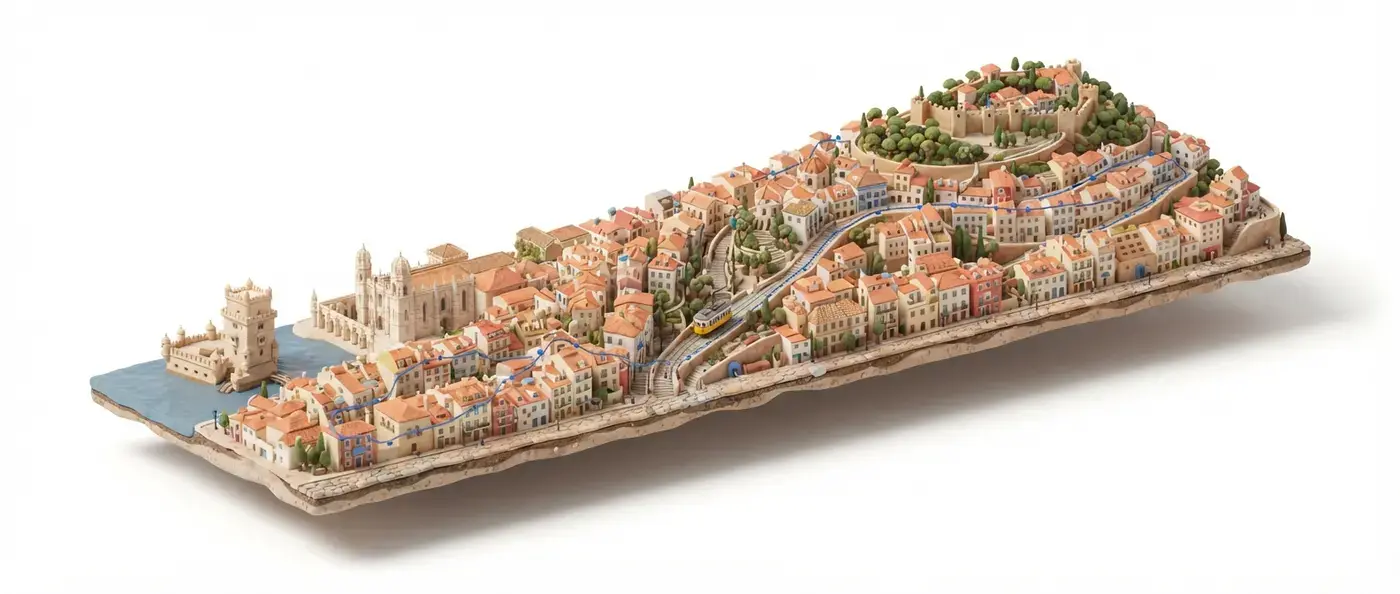
Every stop has its own page with opening days, ticket price, how to get there and where it fits in the itineraries.
Belém
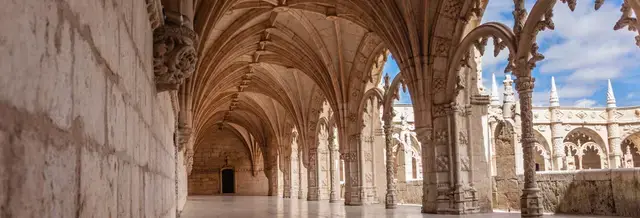
A 16th-century monastery in the Manueline style, with a two-storey cloister and the church where Vasco da Gama is buried. Most of the visit is the cloister and the church.
Booking advisedBelém
A small 16th-century fortress on the riverbank, reopened in May 2026 after restoration. You climb narrow stairs through a few rooms to the terrace.
Book aheadCastle, Alfama and Graça
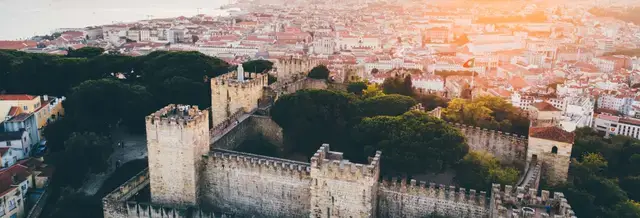
The hilltop castle that looks over the whole city. You walk the walls and towers, and the viewpoint terraces are the main reason to come.
Booking advisedCastle, Alfama and Graça
The oldest quarter of Lisbon, a tangle of lanes, stairs and small squares below the castle. There is no list of things to tick off here. You walk, get lost and stop for a coffee.
Baixa, Chiado and the waterfront
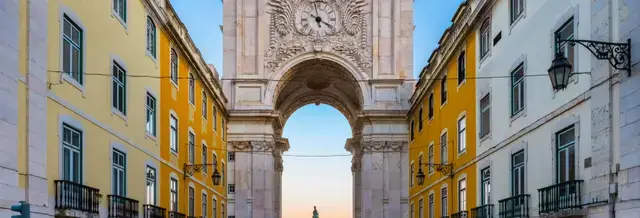
A large riverside square framed by yellow arcades, rebuilt after the 1755 earthquake. The Rua Augusta arch leads from it into the grid of Baixa.
Baixa, Chiado and the waterfront
The roofless Gothic nave of a convent that the 1755 earthquake left standing as a ruin. A small archaeological museum sits in the old apse.
Parque das Nações
One of the larger aquariums in Europe, built around a central tank that you view from two levels. It is a good option in rain and for children.
Booking advisedAvenidas Novas
A private collection of art from Egypt, Mesopotamia, the Islamic world, Europe and Asia, shown in a calm modern building with a garden.
Castle, Alfama and Graça
The Baroque church of Santa Engrácia, now a national monument that holds tombs of Portuguese figures. A staircase leads to a terrace with views over the river.
Castle, Alfama and Graça
A Romanesque cathedral from the 12th century with a plain, fortress-like facade. The visit is ticketed and covers the nave, the ambulatory and the treasury museum.
Castle, Alfama and Graça
A small terrace with tiled panels and a bougainvillea-covered pergola, looking over Alfama's rooftops and the river.
Castle, Alfama and Graça
The highest viewpoint in the old centre, with a wide view of the castle, Baixa and the river. It is quieter than the better-known terraces.
Baixa, Chiado and the waterfront
Chiado has the theatres, old cafés and bookshops. Bairro Alto above it is a grid of narrow streets with restaurants by day and bars by night.
Belém
A monument on the Belém waterfront shaped like a ship's prow, with figures from the Age of Discovery. You can go up to a viewpoint at the top.
Baixa, Chiado and the waterfront
A large food hall in the old Ribeira market, with stalls from well-known Lisbon chefs and restaurants. Easy for a meal where everyone picks something different.
Avenidas Novas
A large sloping park north of Baixa. The top gives a straight view down the avenue to the river, and the Estufa Fria greenhouse is inside the park.
Wi-Fi in hotels, cafés and airports is shared with other guests. A VPN encrypts the connection between your phone or laptop and the VPN's server, which helps when you check email or your bank on the road.
See NordVPNOne day covers the centre: Alfama and the castle, then Baixa and Chiado. Belém needs its own half day, so you have to choose. Start early, because the castle and the Jerónimos Monastery get busy by midday.
Plan about half a day. The monastery takes around two hours, the tower about an hour, and the rest goes on the walk between them and a stop at the waterfront. The tower uses timed slots, so book one before you travel.
The Jerónimos Monastery, the Belém Tower and the National Pantheon are all closed on Monday. The Gulbenkian Museum closes on Tuesday, and the cathedral and the Carmo Convent close on Sunday. Put the Belém sights on a day from Tuesday to Sunday.
The hills make it tiring, and the cobbled pavements are slippery when wet. You can use the metro, the funiculars and trams to avoid the worst climbs. Wear shoes with grip and plan the uphill parts for the morning.