One day in Malaga
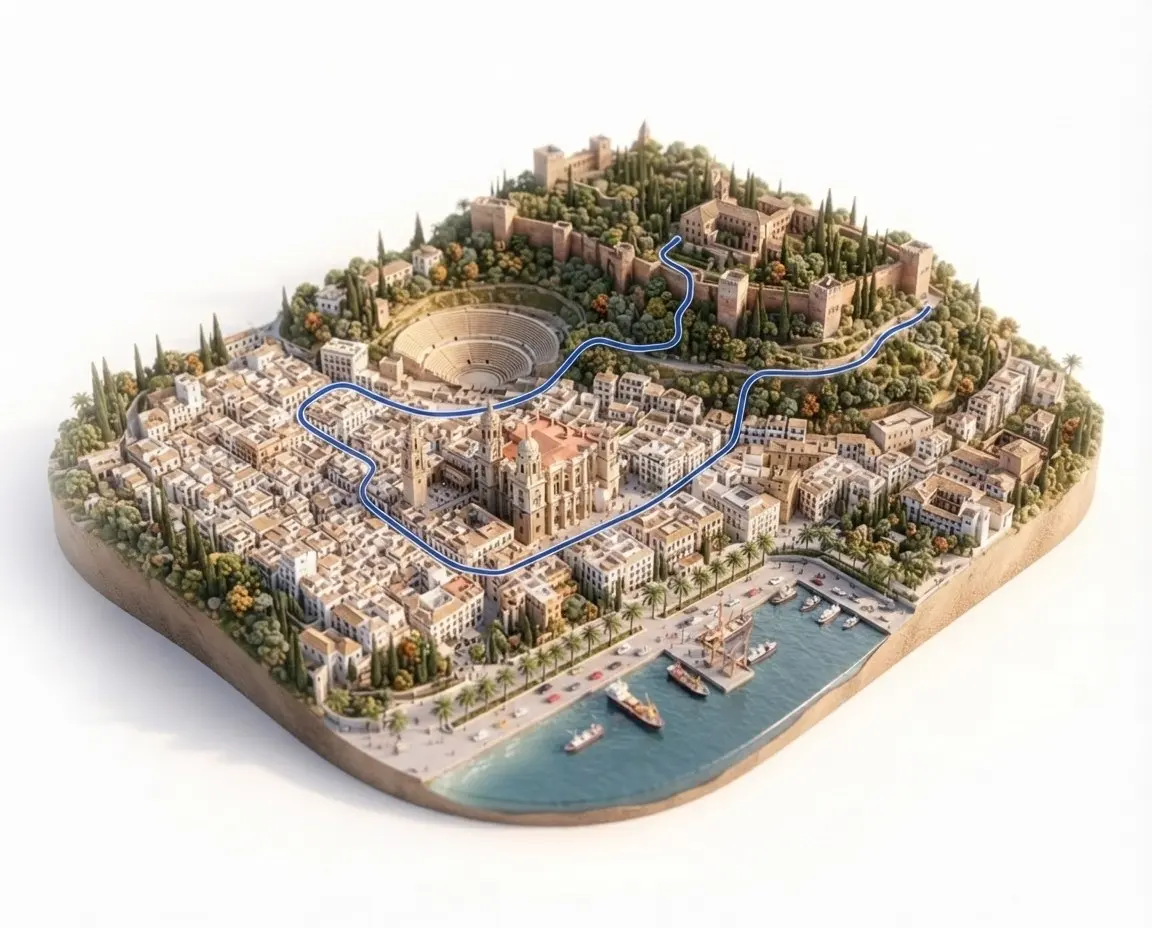
5 stops, about 32 min of walking in total.
- Day 1: Alcazaba and Gibralfaro · Old town and CathedralAlcazaba → Roman Theatre → Málaga Cathedral → Gibralfaro Castle → Muelle Uno and the port promenadeOpen in Google Maps
Spain
Málaga sits between the sea and a hill crowned by two Moorish fortresses, with the old town and the Cathedral on flat ground below. Most sights are a short walk from each other, so the visit is easy to plan around opening days. Mild winters make it a city for every season, with the beach as a bonus.
Data checked on November 2, 2026
Each plan is built from the stop base, with visit time, the walk between stops and a lunch break. Open one and set your pace and arrival day.
5 stops, about 32 min of walking in total.
11 stops, about 1 h 09 of walking in total.
14 stops, about 1 h 12 of walking in total.
April, May, October and November have mild weather, with daytime highs of 20 to 25 degrees and fewer visitors than in summer. July and August are the hottest and busiest months, with highs around 31 degrees and almost no rain. Winter is mild, though it has about five rainy days a month.
Climate averages: Agencia Estatal de Meteorología.
12 to 22 °C · about 4 rainy days a month
Highs rise from about 20 degrees in March to nearly 25 in May. It is a comfortable time for the hill sights, with around three to five rainy days a month.
What to wear: Bring a light jacket for the evening and comfortable shoes for the climbs.
21 to 30 °C · about 0 rainy days a month
Highs reach 28 degrees in June and about 31 in July and August, with almost no rain. Evenings are warm, and the beach is at its busiest.
What to wear: Wear light clothes, a hat and sunscreen, and carry water for the fortresses.
15 to 24 °C · about 4 rainy days a month
September is still warm at about 28 degrees, then highs ease to 24 in October and 20 in November. Rain returns at about five days a month by November.
What to wear: Light layers work, with a rain jacket from October on.
8 to 18 °C · about 5 rainy days a month
Highs stay around 17 to 18 degrees, with lows of 8 to 9. It rains on about five days a month, and many days are clear.
What to wear: A light coat or warm sweater is enough, plus a rain jacket and shoes with grip on wet stone.
A rainy day moves the visit indoors: the Picasso museum, the Pompidou, the Thyssen museum, the Cathedral and the municipal museum are all covered. The Alcazaba and Gibralfaro stay open, but the stone paths get slippery. Rain usually passes in a few hours, so a short wait often works.
Stops under a roof
Summer midday is hot, and the Alcazaba and Gibralfaro have little shade, so go at opening or late in the day. Use the museums and the Cathedral as shade in the middle of the day. Carry water and wear a hat from June to September.
Better outdoors
Per person, without the hotel. Tickets are the prices of the stops in each plan, read on the official sites. Food and transport come from the city figures.
| Plan | Tickets | Transport | Food | Total |
|---|---|---|---|---|
| 1 day | €24 | €5.60 | €32 to €50 | €62 to €79 |
| 2 days | €61 | €11.20 | €65 to €99 | €137 to €172 |
| 3 days | €66.20 | €16.80 | €97 to €149 | €180 to €232 |
Stops with a ticket whose price we could not confirm are left out of the sum.
Sardines grilled on a skewer over an open fire, usually served at beach bars. It is a summer dish, best with a squeeze of lemon.
A mixed plate of small fish and squid, fried in a light batter. Order it to share, with a cold drink.
A cold soup of almonds, garlic and olive oil, often with grapes or melon. It suits hot days.
Fresh anchovies marinated in vinegar and garlic, served cold as a tapa. Fried boquerones are the other common version.
Slices of aubergine fried until crisp and drizzled with cane honey. It is a common tapa in the old town.
A sweet wine from the province, served in small glasses after a meal or with dessert.
Move from bar to bar for one dish and one drink at each, starting around 20:30 in the narrow streets near the Cathedral.
Walk the promenade as the light drops, then stop for a drink at a beach bar.
Take a bus or walk east along the coast to the fishing quarter, where beach restaurants serve grilled and fried fish.
A small show at a tablao in the old town gives a close view of the dance and the guitar.
A short catamaran ride from the port shows the city and the coast from the water.
From Málaga airport the C1 train takes about 12 minutes to the centre, and the airport bus line A takes about 20 minutes. Málaga María Zambrano is the main station, about 20 minutes on foot from the old town. The old town is also a short taxi ride from either.
Most sights are close together, so walking is the main way to get around. Buses cover the gaps, and bus 35 climbs to Gibralfaro about every 30 minutes. A single bus ticket costs 1.40 EUR, so a pass is not worth planning around.
Every stop has its own page with opening days, ticket price, how to get there and where it fits in the itineraries.
Alcazaba and Gibralfaro
A Moorish palace-fortress on the hill above the old town, with three lines of walls, gates, courtyards and gardens. It takes a steady uphill walk, with views of the port at every turn.
Booking advisedAlcazaba and Gibralfaro
A military castle on the summit above the Alcazaba, reached by a walled path or by bus. Its walkway runs round the top of the walls with the widest view of the city.
Old town and Cathedral
A Renaissance cathedral with a tall nave and one tower left unfinished, which gave it the nickname La Manquita, the one-armed lady. The ticket includes an audioguide.
Booking advisedAlcazaba and Gibralfaro
The ruins of a Roman theatre at the foot of the Alcazaba, with the tiered seating and stage area visible. Entry is free and takes less than an hour.
Old town and Cathedral
The main museum of the painter born in the city, set in a restored palace in the old town. It shows his work across his whole career, along with temporary exhibitions.
Booking advisedPort and Malagueta
A branch of the Paris museum in a glass cube on the port, with a semi-permanent display of modern and contemporary art. It makes a good wet-weather or midday stop.
Old town and Cathedral
A museum of Spanish painting from the 19th century, mostly Andalusian scenes, in a restored palace in the old town. It is small enough for a short visit.
Old town and Cathedral
The central food market, housed in a 19th century iron hall with a stone gate from an older building. Stalls sell fish, meat, fruit, cheese and olives, with tapas bars along the sides.
Old town and Cathedral
The house on Plaza de la Merced where Picasso was born, turned into a small museum with family furniture, documents and works. It is quicker than the main museum and far cheaper.
Port and Malagueta
A pedestrian promenade along the harbour, with shops, restaurants and terraces facing the water. It is an easy evening walk after the museums close.
Old town and Cathedral
The main pedestrian street of the old town, lined with shops and uniform façades, leading to the central square. A good place to orient yourself and pass between sights.
Botanical garden
A large historic garden north of the centre, with subtropical plants, a lake, waterfalls and a viewpoint over the city. It is a half-day excursion on a clear day.
Paseo de Reding and the east
The city's municipal museum, with art and heritage collections shown in permanent and temporary displays. A calm indoor visit near the Paseo del Parque.
Port and Malagueta
The city beach nearest the port, a long strip of sand with showers, a promenade and beach bars. It is a short walk from the old town.
Paseo de Reding and the east
A walled garden cemetery used by Protestant foreigners since the 19th century, with tombs among cypress and palm trees. It is quiet and short.
Wi-Fi in hotels, cafés and airports is shared with other guests. A VPN encrypts the connection between your phone or laptop and the VPN's server, which helps when you check email or your bank on the road.
See NordVPNOne day covers the Alcazaba and the Roman Theatre, the Cathedral and the old town streets, but not much more. The hill sights alone take most of a morning. A second day adds the museums, the port and the beach without rushing.
For the Picasso museum, yes, since all tickets are sold online and busy days can sell out. For the Cathedral, buying online avoids the ticket queue. The Roman Theatre is free and needs no booking, and a guided Alcazaba visit with entry included skips the ticket queue.
The Roman Theatre, the Thyssen museum and the municipal museum close on Mondays, and the Pompidou closes on Tuesdays. The Atarazanas market is closed on Sundays and shuts at 15:00 on other days. The Cathedral opens only from 14:00 on Sundays.
The Roman Theatre is always free. The Alcazaba and Gibralfaro are free on Sundays from 14:00, the Picasso museum in the last two hours on Sunday, and the Pompidou from 16:00 on Sunday. These slots are busy, so expect queues.