One day in Brussels
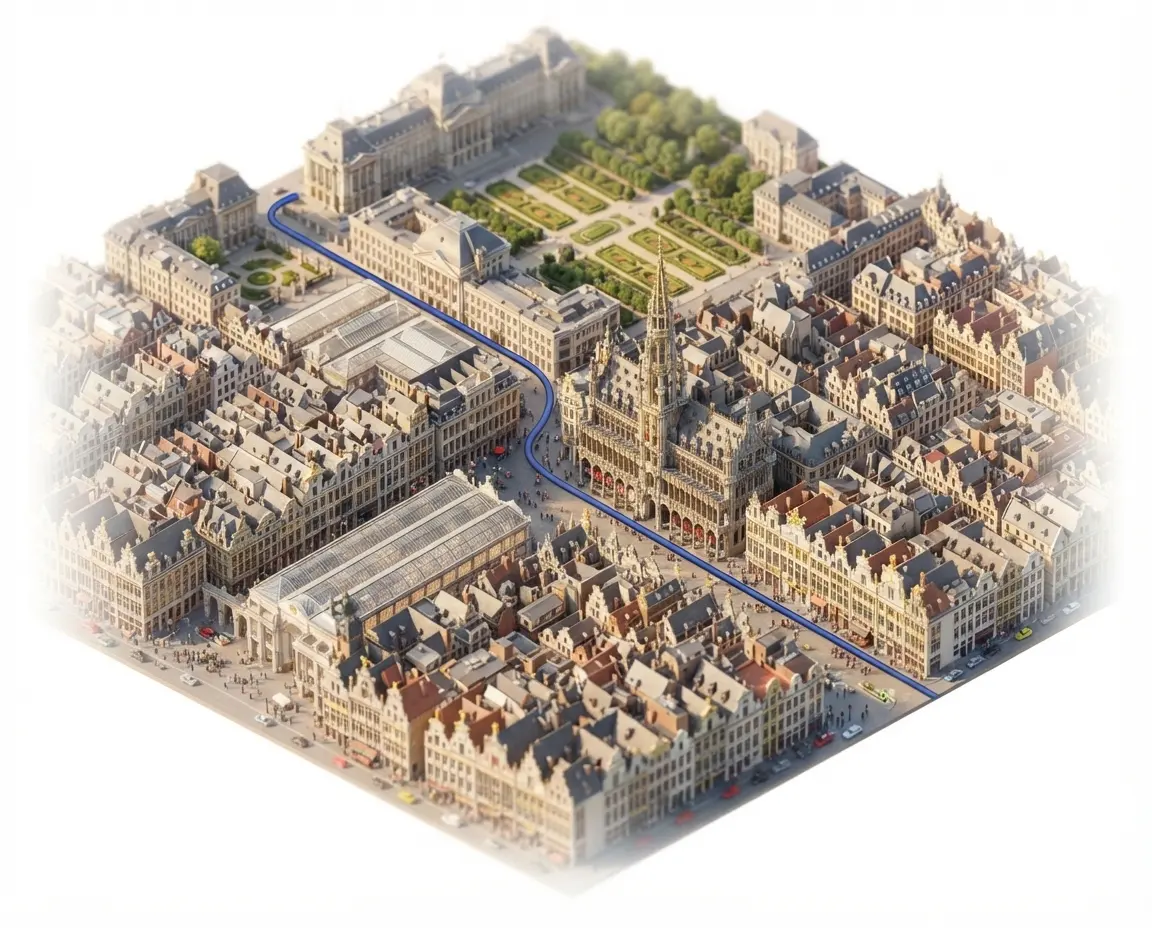
5 stops, about 31 min of walking in total.
- Day 1: Heysel and the Atomium · Historic centreAtomium → Manneken Pis → Cathedral of St Michael and St Gudula → Comic Art Museum → Grand-PlaceOpen in Google Maps
Belgium
Brussels is a compact capital where most of the main sights sit within a 20 minute walk of the Grand-Place. The centre is split between a lower town of squares, arcades and cafes and an upper town of museums and parks, and French and Dutch are used side by side on every sign. Comics, Art Nouveau fronts and lambic beer give the city its character more than any single monument does.
Data checked on October 5, 2026
Each plan is built from the stop base, with visit time, the walk between stops and a lunch break. Open one and set your pace and arrival day.
5 stops, about 31 min of walking in total.
10 stops, about 1 h 06 of walking in total.
13 stops, about 1 h 14 of walking in total.
May, June and September are the best months: highs of 18 to 21 degrees, long evenings and fewer crowds than midsummer. July and August are warm and busy, and December fills with visitors for the Christmas markets. January and February are cold and grey, which suits museums better than walking.
Climate averages: Royal Meteorological Institute of Belgium.
6 to 15 °C · about 15 rainy days a month
March is still cold with highs near 11 degrees, April reaches about 15 and May about 18. Showers are frequent, but parks turn green and the terraces open again.
What to wear: Pack layers and a light waterproof jacket, and shoes that cope with wet cobbles.
13 to 22 °C · about 14 rainy days a month
Summer highs are 21 to 23 degrees with long evenings. July and August are the busiest months, and hot days above 30 degrees are rare but they do happen.
What to wear: Wear light clothes by day and carry a thin jacket for the evening and for sudden showers.
8 to 15 °C · about 16 rainy days a month
September stays mild at around 20 degrees, October drops to about 15 and November to about 10. Rain becomes more frequent and the days shorten quickly.
What to wear: Bring a warm layer, a rain jacket and closed shoes from October.
2 to 7 °C · about 18 rainy days a month
Winter highs are 6 to 7 degrees and nights sit just above freezing. Snow falls on a few days each month from December to February, and daylight is short. The Christmas market in December brings crowds.
What to wear: Wear a warm coat, hat and gloves, and boots with grip for wet and icy cobbles.
Brussels sees some rain on about half the days of the year, so keep an indoor option for each day. The fine arts museums, the Musical Instruments Museum, the Comic Art Museum, the Art and History Museum and the Parlamentarium all work in wet weather, and the Galeries Royales Saint-Hubert give you a covered walk in the centre. The panorama at the Atomium and the view from Place Poelaert are poor in low cloud, so save them for a clearer day.
Stops under a roof
Summer afternoons can reach the low 30s on the hottest days, and there is little shade on the Grand-Place or on Place Poelaert. Put those stops in the morning or evening, and use the museums or the cathedral in the middle of the day. The Cinquantenaire park and the Mont des Arts gardens offer some shade, and a bottle of water is enough for a day on foot.
Better outdoors
Per person, without the hotel. Tickets are the prices of the stops in each plan, read on the official sites. Food and transport come from the city figures.
| Plan | Tickets | Transport | Food | Total |
|---|---|---|---|---|
| 1 day | €31 | €9 | €44 to €68 | €84 to €108 |
| 2 days | €44 | €18 | €88 to €136 | €150 to €198 |
| 3 days | €72 | €27 | €132 to €204 | €231 to €303 |
Twice-fried potatoes in a paper cone with a choice of sauces, bought at a chip stand. They are a standard snack at any hour and are often eaten standing in the street.
Mussels cooked in a pot with white wine or herbs, served with fries. They are a staple of brasseries, and the main season runs from late summer through spring.
A light, rectangular waffle with a crisp edge, dusted with sugar and sold hot from stalls. It is lighter than the denser Liège waffle that is also common here.
A slow-cooked beef stew made with dark beer and onions, usually served with fries or bread. It is the standard winter lunch in a traditional brasserie.
Sour beers fermented spontaneously in oak barrels, a local style that is rare outside the Brussels area. Order one in a traditional cafe and ask for a small glass if you have never tried it.
Filled chocolates sold by weight in shops around the Sablon and the Galeries Royales Saint-Hubert. Buy a small box to taste a few makers rather than one large one.
Painted comic strip murals cover walls across the lower town, and the Comic Art Museum lists a comic strip route. A walk to find a few of them is a good way between the museum and the Grand-Place.
Brussels has a large stock of Art Nouveau houses from around 1900. A short walk through Saint-Gilles and Ixelles shows iron balconies and curved windows that most visitors never reach.
Pair a plate of cheese with a gueuze or a kriek in an old-style cafe in the lower town. Ask the staff to choose, since the sour styles taste different from other Belgian beers.
Spend an hour going between small chocolate shops on the streets around the Sablon square. Buying two pralines in each shop lets you compare makers without carrying much home.
A large market beside Brussels-Midi station runs on Sunday morning with food, flowers and clothes. It is a good place to see how locals shop.
From Brussels Airport, trains run from the station under the terminal to the centre, and the ride to Brussels-Central takes about 20 minutes. Brussels-Central is a short walk from the Grand-Place. From Charleroi airport, shuttle buses to Brussels-Midi take around an hour. At Brussels-Midi, any train going on to Brussels-Central reaches the centre in a few minutes, and the metro and trams also serve the station.
The centre is walkable, and the Grand-Place, the cathedral, the Galeries Royales and Manneken Pis are all within 15 minutes of each other. The upper town is a climb, so the Mont des Arts steps and the slopes add effort. The metro, trams and buses share one ticket system run by STIB, and the Atomium, the European Quarter and Cantillon are easier by metro. The day pass pays off from about four rides.
Every stop has its own page with opening days, ticket price, how to get there and where it fits in the itineraries.
Historic centre
The market square at the centre of the old town, closed in by the Gothic town hall and the guild houses. It is open at any hour and takes little time, but it is worth seeing both by day and after dark.
Heysel and the Atomium
A 102 metre steel model of an iron crystal, built for the 1958 World's Fair. Five of the nine spheres are open, with exhibitions inside and a panorama at the top.
Booking advisedRoyal Quarter and Sablon
Two large museums that share a ticket system: the Old Masters Museum, with Flemish painting from the 15th century onwards, and the Magritte Museum on Place Royale. Together they are the main art stop in the city.
Historic centre
The Gothic cathedral of Brussels, free to enter, with a treasury, Romanesque remains and a crypt that charge separately. The twin towers face a small square on the slope above Gare Centrale.
Historic centre
A museum of Belgian and international comics in a former warehouse designed by Victor Horta. It is quick to read and rewarding even if you do not read comics.
Historic centre
A glass-roofed shopping arcade of the 1840s with three connected galleries. Walk through it for the architecture and the cafe windows rather than to shop.
Historic centre
A small bronze fountain figure on a street corner near the Grand-Place. The visit lasts a few minutes, and the statue is smaller than most people expect.
Royal Quarter and Sablon
One of the world's large collections of musical instruments, in an Art Nouveau building beside the Mont des Arts. A free multimedia guide plays the sound of the instruments as you walk past them.
Royal Quarter and Sablon
An upper-town square and the streets around it, known for antique dealers, chocolate makers and the church of Notre-Dame du Sablon. It is best on a weekend, when the antiques market is open.
European Quarter and Cinquantenaire
A very large general museum in the Cinquantenaire park, with antiquities from Egypt, Greece and Rome, European decorative arts and collections from other continents. Pick two or three sections rather than the whole building.
European Quarter and Cinquantenaire
A formal park laid out in 1880 for the 50th anniversary of Belgian independence, dominated by a triumphal arch. It works as a quiet stop between museums, and the arch frames the view along the avenue.
European Quarter and Cinquantenaire
The visitor centre of the European Parliament, with interactive exhibits on how the Union works. Entry is free and the visit takes about 90 minutes.
Booking advisedMarolles and the south
A working lambic brewery and museum of the gueuze, in Anderlecht. You walk through the cellars and old barrels at your own pace and finish with three samples.
Booking advisedMarolles and the south
The daily flea market in the Marolles, with more than 300 stalls of second hand objects, furniture, clothes and bric a brac. The first hours are the best.
Marolles and the south
A viewpoint over the lower town from the front of the Palace of Justice, a courthouse built on a vast scale. You see the roofs of the city and the Marolles below.
Royal Quarter and Sablon
A terraced garden that links the lower and upper town, laid out for the 1910 World's Fair. It gives a view over the old town.
One day covers the Grand-Place, the Galeries Royales Saint-Hubert, Manneken Pis and one museum if you keep to the centre. It will not reach the Atomium or the European Quarter. Check that the museum you want is not closed on a Monday.
The Royal Museums of Fine Arts, the Musical Instruments Museum and the Art and History Museum are closed on Mondays. The Comic Art Museum is closed on Mondays except in July and August. The Atomium and the Parlamentarium are open on Mondays.
Tickets are sold at the door, but the official site lists 11:00 to 15:00 as the busiest hours. Arriving at opening or after 15:00, or buying online, saves most of the wait.
Bruges is about an hour away by train and is the usual choice for a day out. It is a small, preserved medieval centre with canals and cobbled streets, and it fills up by late morning in summer. Go early and plan to be back in Brussels by evening.