One day in Venice
4 stops, about 12 min of walking in total.
- Day 1: St Mark's Square · RialtoSt Mark's Square → Doge's Palace → St Mark's Basilica → Rialto BridgeOpen in Google Maps
Italy
Venice has no cars, so every visit happens on foot or by vaporetto. The big sights cluster around St Mark's Square at the east end, while Dorsoduro, San Polo and Cannaregio fill the west and north with museums, churches and quieter streets. Lanes are narrow and every canal means a bridge, so distances feel longer than they look on a map.
Data checked on October 5, 2026
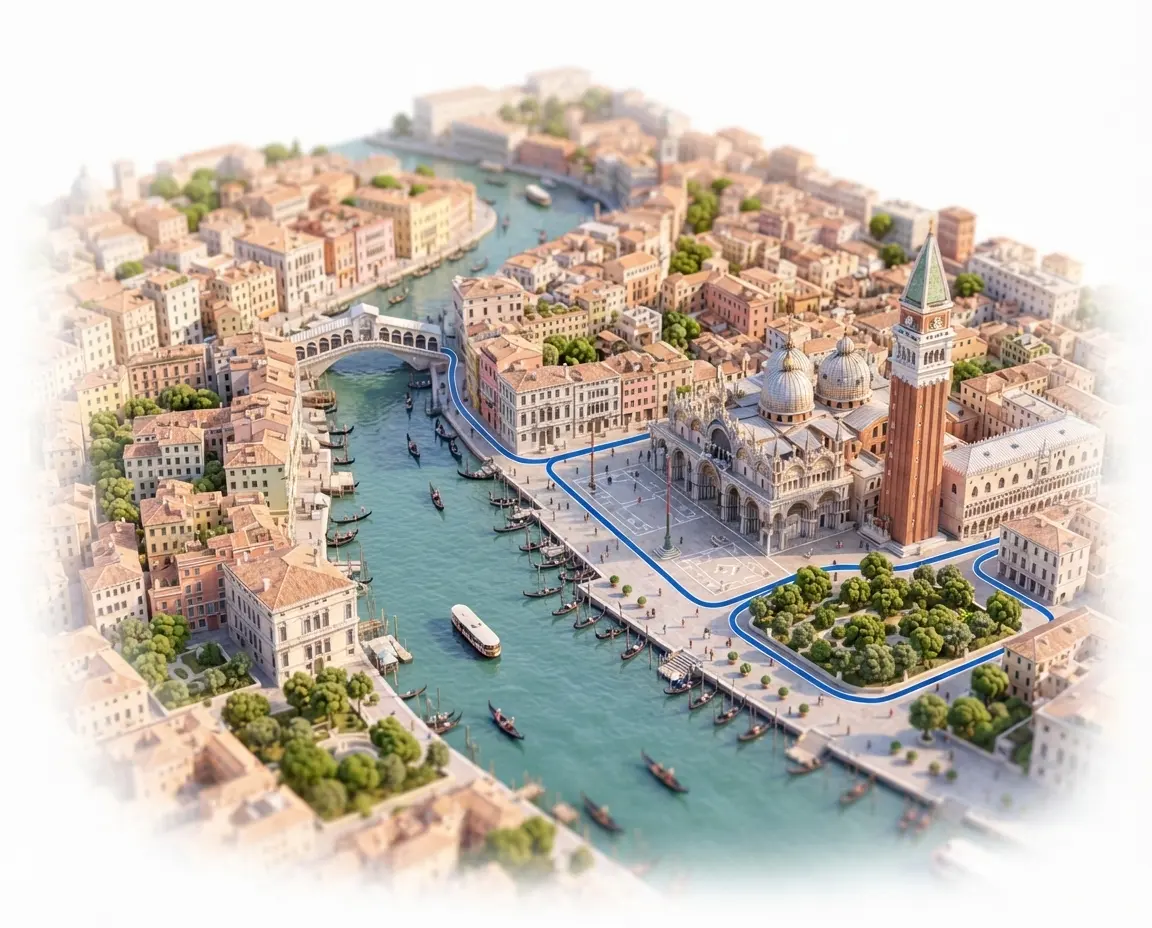
Each plan is built from the stop base, with visit time, the walk between stops and a lunch break. Open one and set your pace and arrival day.
4 stops, about 12 min of walking in total.
8 stops, about 50 min of walking in total.
12 stops, about 1 h 01 of walking in total.
April, May, September and October balance mild weather with manageable crowds. June to August is hot and humid and brings the largest crowds, and winter is cold and damp with fog but few visitors. Carnival in February and Easter fill the city outside the summer peak.
Climate averages: Servizio Meteorologico dell'Aeronautica Militare / ISPRA.
9 to 17 °C · about 7 rainy days a month
March is cool and showery, and April and May warm to highs of about 17 and 22 degrees with long days. Crowds build from Easter onwards.
What to wear: Bring light layers and a waterproof jacket, with shoes that grip wet stone.
18 to 28 °C · about 7 rainy days a month
Highs reach about 28 degrees and the air stays humid, with some thunderstorms. The lanes and the square are at their most crowded.
What to wear: Wear light clothes that still cover shoulders and knees for churches, plus a hat and shoes with a good sole.
11 to 19 °C · about 6 rainy days a month
September is still warm at about 24 degrees, October drops to 19 and November to 13, with more fog and the first high tides. The crowds thin out from October.
What to wear: Pack layers, a rain jacket and waterproof shoes in case of high water.
1 to 8 °C · about 6 rainy days a month
Highs sit around 8 or 9 degrees and nights fall close to freezing, with damp air and fog. Outside the Carnival weeks the city is quiet.
What to wear: Wear a warm coat, hat and gloves, and waterproof boots for any high water.
Rain falls on five to nine days a month and is spread across the year. A wet day suits the Accademia, the Doge's Palace, the Peggy Guggenheim, Ca' Rezzonico, the Frari and the Scuola di San Rocco. The basilica interior is dry but the queue outside is not, so book a slot. High water is mostly an autumn to spring problem, and waterproof shoes help.
Stops under a roof
Summer heat builds from late morning, and there is little shade in the square or on the bridges. Do the open sights early or after 17:00, use the museums and churches in the middle of the day, and carry water. Public drinking fountains are scattered around the city, so a refillable bottle helps.
Better outdoors
Per person, without the hotel. Tickets are the prices of the stops in each plan, read on the official sites. Food and transport come from the city figures.
| Plan | Tickets | Transport | Food | Total |
|---|---|---|---|---|
| 1 day | €45 | €25 | €42 to €68 | €112 to €138 |
| 2 days | €80 | €50 | €84 to €135 | €214 to €265 |
| 3 days | €97 | €75 | €126 to €203 | €298 to €375 |
Stops with a ticket whose price we could not confirm are left out of the sum.
Small Venetian snacks of bread, fish, cheese or meat, eaten standing at a bar counter with a small glass of wine.
Salt cod whipped into a creamy spread and served on toasted bread or polenta, often as a cicchetto.
Fried sardines marinated with onions, vinegar, raisins and pine nuts, served cold as a starter.
A thick Venetian soup of rice and peas, usually eaten in spring when the peas are fresh.
Thick wholewheat pasta in a sauce of onions and salted anchovies, a classic Venetian dish.
The Veneto aperitivo of prosecco, a bitter liqueur and soda water, with a Venetian version made with Select.
A traghetto is a gondola ferry that crosses the canal at several points. The ride lasts a couple of minutes, and you stand for it.
Between 07:00 and 08:00 the city belongs to residents and delivery boats. It is the best time to see the quiet side of the lanes near the Rialto.
The point at the end of the Zattere looks across the basin to St Mark's and the lagoon. Arrive a little early for a place on the steps.
Several churches host baroque music concerts in the evening, often featuring Vivaldi. Book ahead in high season.
The vaporetto takes about an hour to the Lido, where there are beaches and bicycle paths. It makes a change from the stone of the centre.
Marco Polo airport is on the mainland. A bus to Piazzale Roma takes about 20 minutes, and boat services run to the city in about an hour or more depending on the stop, with a water taxi as the quick option. Trains arrive at Venezia Santa Lucia, which opens onto the Grand Canal with vaporetto landings outside the door. Mestre station is on the mainland, one short train ride from Santa Lucia.
Venice is walkable, but allow more time than the map suggests because of the crowds, steps and bridges. The vaporetto is useful for long hops along the Grand Canal, and the 24 hour pass pays off from about the third separate ride. If you stay between St Mark's and the Rialto you may not need a ticket at all. Wheeled luggage is a trial on the bridges.
Every stop has its own page with opening days, ticket price, how to get there and where it fits in the itineraries.
St Mark's Square
The main square of Venice, closed in by the basilica, the arcaded Procuratie and the Campanile, with the lagoon at the open end. It is free and open at all hours.
St Mark's Square
The Byzantine basilica covered in gold mosaic, begun in 828 to house the relics of St Mark. Entry is by booked time slot, and the Pala d'Oro, the museum and the loggia over the porch cost extra.
Book aheadSt Mark's Square
The seat of the Venetian Republic, with the state rooms, the Great Council Hall and the Bridge of Sighs. The ticket also covers the Correr Museum, the Archaeological Museum and the Marciana Library rooms.
Booking advisedGrand Canal
The main waterway of Venice, lined with palaces from the station to St Mark's. Line 1 stops at every landing, so one ticket turns public transport into a slow ride past the facades.
Rialto
A stone arch with two rows of shops, built between 1588 and 1592 and for centuries the only bridge over the Grand Canal. The view from the outer walkways is the reason to cross.
Dorsoduro
The main collection of Venetian painting, from gold ground altarpieces of the 14th century to Titian, Tintoretto and Veronese. The rooms are compact enough to see in a morning.
Booking advisedSt Mark's Square
The bell tower on the square, with a lift to a viewing gallery above the roofs. It is the highest viewpoint in the historic centre.
Booking advisedDorsoduro
The domed baroque basilica at the mouth of the Grand Canal, built as a thanks offering after a plague. The rotunda is free to enter, and the sacristy with Titian's paintings needs a ticket.
San Polo
A large Gothic Franciscan church with Titian's Assumption over the high altar. It sits in San Polo, away from the main crowds.
Dorsoduro
A modern art museum in an unfinished palace on the Grand Canal, with Cubist, Surrealist and Abstract Expressionist work and a sculpture garden.
Booking advisedRialto
Fruit, vegetable and fish stalls beside the Grand Canal, where Venetians have bought food for centuries. It is a morning sight.
San Giorgio Maggiore
A church by Palladio on its own island opposite St Mark's, three minutes by vaporetto. Entry to the church is free, and the bell tower is closed for works.
San Polo
A confraternity hall decorated with Tintoretto's paintings from wall to ceiling. Allow time to look up.
Dorsoduro
A broad quay on the south side of Dorsoduro facing the Giudecca Canal, with sun, open views and long benches. The walk ends at Punta della Dogana.
Cannaregio
The oldest Jewish quarter in Europe, set up in 1516 in the north of Cannaregio. Tall houses, five synagogues and a museum surround a quiet square.
Dorsoduro
A baroque palace on the Grand Canal that now houses the museum of 18th century Venice, with period rooms, ceiling frescoes by Tiepolo and paintings by Guardi and Longhi.
One day covers St Mark's Square, the basilica, the Doge's Palace and a ride on the Grand Canal if you book the basilica ahead. You will miss the Dorsoduro museums and the quieter districts of San Polo and Cannaregio. Walking is slow because of the bridges, so keep the plan tight.
Yes. Tickets are named and entry is only in the slot you book, with five minutes of tolerance. The Doge's Palace and the Accademia recommend booking too, and the Accademia is closed on Mondays.
A single ticket is valid for 75 minutes on the whole network, and the 24 hour pass is cheaper from about the third separate ride. Line 1 along the Grand Canal doubles as a sightseeing ride. If you stay between St Mark's and the Rialto, walking is often as quick.
No day is fully clear. The Accademia is shut on Monday, and the Peggy Guggenheim and Ca' Rezzonico are shut on Tuesday. On Sundays the basilica opens at 14:00 and the Frari at 13:00, so Sunday morning is the weak spot. The Doge's Palace is open every day.