One day in Seville
4 stops, about 34 min of walking in total.
- Day 1: Cathedral and Alcázar · Arenal and the riverReal Alcázar → Seville Cathedral and Giralda → Torre del Oro → Metropol Parasol (Las Setas)Open in Google Maps
Spain
Seville packs a royal palace, one of the largest cathedrals in the world and a former Jewish quarter into a few flat square kilometres on the east bank of the Guadalquivir. Most of the big sights are a short walk apart, and the district of Triana sits just across the river. The city is built around the heat, so the day runs early, pauses in the afternoon and starts again after dark.
Data checked on October 5, 2026
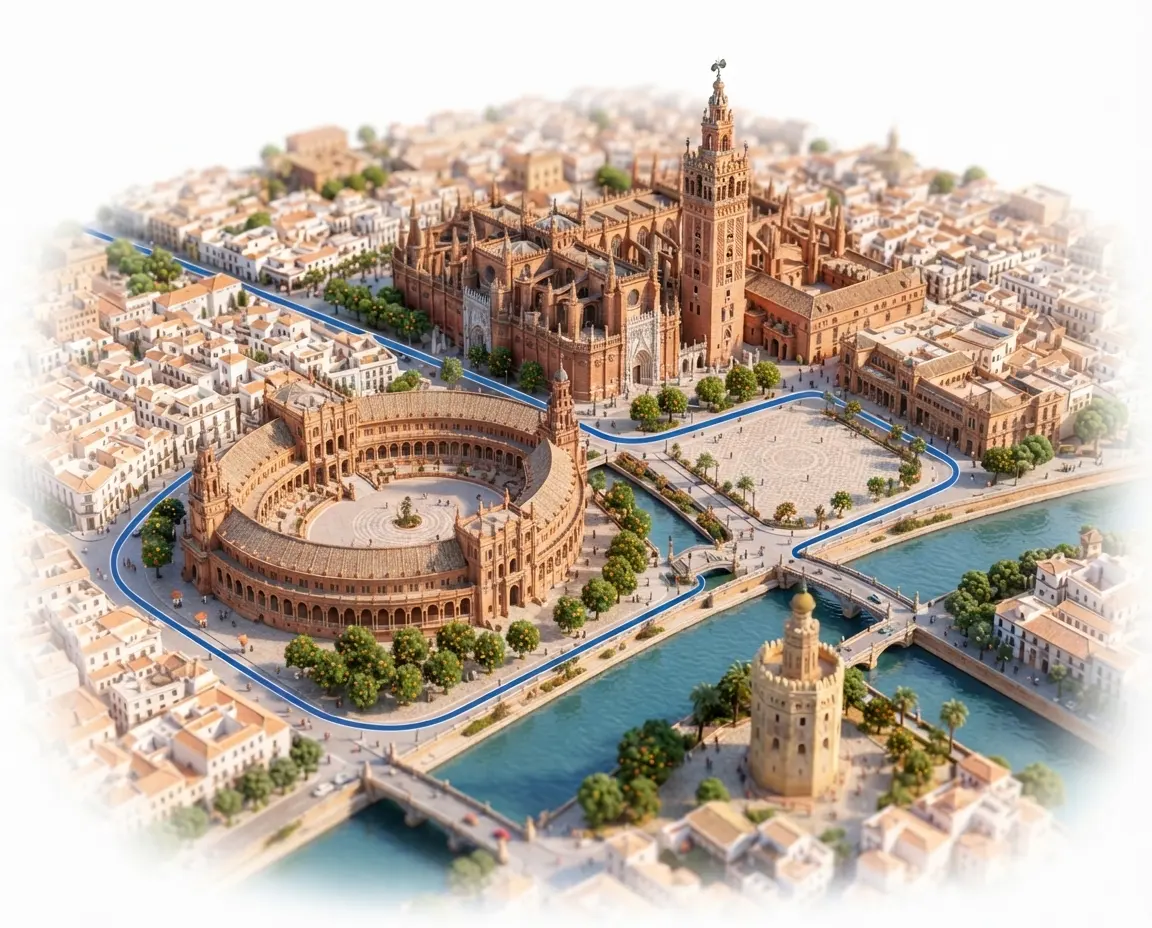
Each plan is built from the stop base, with visit time, the walk between stops and a lunch break. Open one and set your pace and arrival day.
4 stops, about 34 min of walking in total.
9 stops, about 1 h 27 of walking in total.
14 stops, about 2 h 28 of walking in total.
March, October and November give daytime highs of 20 to 26°C and manageable queues. April and early May are the most popular months, and Holy Week and the April Fair bring the biggest crowds and the highest hotel demand. July and August average 36°C in the afternoon, so most sightseeing moves to early morning and evening.
Climate averages: Agencia Estatal de Meteorología.
12 to 25 °C · about 5 rainy days a month
Highs rise from 22°C in March to 28°C in May, with a few rainy days in March and April. April brings Holy Week and the April Fair, when streets close and the old town fills.
What to wear: Layers for cool mornings, a light rain jacket in March and shoes that grip cobbles.
20 to 35 °C · about 0 rainy days a month
Highs reach 36°C in July and August and rain almost never falls. The city empties in the afternoon and wakes up after 21:00.
What to wear: Light cotton, a hat, sunscreen and a water bottle, plus a thin layer for cold air conditioning indoors.
14 to 26 °C · about 5 rainy days a month
September is still hot at about 32°C, but October (26°C) and November (20°C) are comfortable. Rain returns from October, around six days a month.
What to wear: Short sleeves in October, a light jacket and a small umbrella from November.
7 to 17 °C · about 6 rainy days a month
Highs sit near 16 to 18°C and nights drop to around 6°C, with rain on five to seven days a month. Sights are quiet and the sun is low.
What to wear: A jacket, layers and waterproof shoes, since tiled floors and cobbles get slippery when wet.
Rain falls on about five to seven days a month from October to April and almost never in summer. On a wet day the cathedral, the Museo de Bellas Artes, the Archivo de Indias, the Hospital de los Venerables and El Salvador keep you dry. The Alcázar and the Casa de Pilatos have covered rooms, but most of the route crosses open courtyards and gardens.
Stops under a roof
From June to September highs pass 32°C and the midday sun is harsh. Do the Alcázar, Plaza de España and the park early, spend 14:00 to 18:00 in a museum, a church or a shaded Santa Cruz lane, and go out again after 19:00. Carry water, since shade between the sights is patchy.
Better outdoors
Per person, without the hotel. Tickets are the prices of the stops in each plan, read on the official sites. Food and transport come from the city figures.
| Plan | Tickets | Transport | Food | Total |
|---|---|---|---|---|
| 1 day | €47.50 | €5 | €26 to €45 | €78 to €98 |
| 2 days | €47.50 | €10 | €51 to €91 | €109 to €148 |
| 3 days | €85 | €15 | €77 to €136 | €177 to €236 |
A thick cold soup of tomato and bread, usually topped with ham and egg. It is the standard first course on hot days.
Spinach and chickpeas with cumin and garlic, a classic Seville tapa that tastes better than it sounds.
Slow-cooked meat and sausage mashed into a spread and served in a small bread roll. It is a cheap, filling tapa found in old bars.
Pork tenderloin cooked in garlic and whisky, served in slices. It is a Seville bar standard, usually ordered by the portion.
A mixed plate of lightly floured and fried fish and seafood, eaten at lunch with a cold drink.
A long drink of dry sherry and lemon soda, served over ice. People have it at the April Fair and on hot afternoons all year.
Seville is one of the home towns of flamenco, and small rooms in Triana and Santa Cruz put on short evening shows with guitar, song and dance at close range.
Pick a few bars around Triana, the Alameda or the old centre and order one or two small plates in each. Locals stand at the counter and move on after a drink.
The Roman city ruins and amphitheatre lie a short bus ride from Seville in the town of Santiponce. It is an easy half day if you have time after the main sights.
The flat riverside path and the quiet streets around the park suit a slow ride, and the city has public bikes for short trips.
Several bathhouses in the old centre offer warm pools, steam rooms and massage in Moorish-style rooms. They are a good way to end a hot day.
The airport is about 10 km from the centre, and the airport bus (line EA) and taxis both take roughly 30 minutes. Trains arrive at Santa Justa station, about 2 km east of the cathedral, which is a 25 to 30 minute walk or a short bus or taxi ride. High-speed trains from Madrid take about two and a half hours.
The old centre is compact and flat, and most sights are within 25 minutes on foot of each other. Buses and the Metrocentro tram cover the rest, with a single ticket at 1.40 euros. The 1-day tourist card costs 5 euros plus a card deposit, so it pays off only with four or more rides, and most visitors walk.
Every stop has its own page with opening days, ticket price, how to get there and where it fits in the itineraries.
Cathedral and Alcázar
A royal palace still used by the Spanish crown, rebuilt in Mudéjar style under Pedro I in the 14th century. The route runs through the palace rooms and out into the gardens, and takes most of a morning.
Booking advisedCathedral and Alcázar
One of the largest cathedrals in the world, built on the site of the city's main mosque. The standard ticket covers the interior and the climb up the Giralda bell tower.
Booking advisedMaría Luisa Park
A semicircular brick and tile building made for the 1929 Ibero-American Exposition, with a canal along its front. Entry is free, and the square works best early or late.
Santa Cruz
The former Jewish quarter, a tangle of narrow lanes, small squares and orange trees right beside the cathedral. There is no entrance and no queue.
María Luisa Park
Seville's main park, with palms, orange trees, fountains, tiled benches and shaded paths. It is the easiest place to sit down in the middle of the day.
Old centre and north
A wooden canopy over Plaza de la Encarnación, finished in 2011. A lift takes you to a walkway on top with a view over the old town roofs.
Booking advisedTriana
The district across the Guadalquivir, long home to sailors, potters and flamenco families. It is a place to walk, eat and look back at the old town from the other bank.
Santa Cruz
A palace of the Dukes of Medinaceli that mixes Mudéjar, Gothic and Renaissance styles. It has a tiled courtyard, a garden and an upper floor with its own ticket.
Old centre and north
The main art museum of Andalusia, in a former convent, with the strongest collection of Seville Baroque painting. Murillo, Zurbarán and Valdés Leal are the names to look for.
Arenal and the river
One of the oldest bullrings in Spain, open for visits outside bullfighting days. The visit takes in the ring, the stands and a museum.
Arenal and the river
A 13th century riverside watchtower that now holds a small maritime museum. It is quick to visit and sits on the best stretch of the river path.
Cathedral and Alcázar
The archive of the Spanish empire in the Americas, in a 16th century Renaissance building that was once the merchants' exchange. Entry to the monumental area is free.
Santa Cruz
A 17th century Baroque building in Santa Cruz, once a home for elderly priests. The visit takes in a courtyard, a church and exhibition rooms.
Old centre and north
A long tree-lined square north of the centre, laid out in 1574. It is where locals go in the evening, not a sight to tick off.
Old centre and north
The largest church in Seville after the cathedral, a Baroque church on the site of an old mosque. It takes under an hour and is far quieter than the cathedral.
One day covers the Alcázar, the cathedral and a walk through Santa Cruz if you start early and book ahead. It leaves out María Luisa Park, Triana and the museums. A second day lets you slow down, which matters in the heat.
Both sell tickets at the door, but queues build at weekends and in spring. Buying online lets you skip the box office, and the cathedral ticket carries an access time.
March, October and November have daytime highs between 20 and 26°C and fewer crowds than April. April brings Holy Week and the April Fair, which fill the city. July and August average 36°C in the afternoon.
Yes. The old centre is flat and the Alcázar is about 25 minutes from Triana on foot. Plaza de España is the one stop that is farther away, about 15 minutes from the cathedral.