Hungary

Budapest itineraries

Budapest is two cities facing each other across the Danube. Buda has the castle hill and the old streets, and Pest has the Parliament, the boulevards, the markets and most of the evening life. The sights are spread along the river, so the metro and the trams do a lot of the work.

  • 16 stops checked
  • 2 to 3 days
  • 4 to book ahead
  • Best in April to June and September to October

Data checked on October 5, 2026

Budapest

Itineraries for Budapest

Each plan is built from the stop base, with visit time, the walk between stops and a lunch break. Open one and set your pace and arrival day.

1

One day in Budapest

6 stops, about 54 min of walking in total.

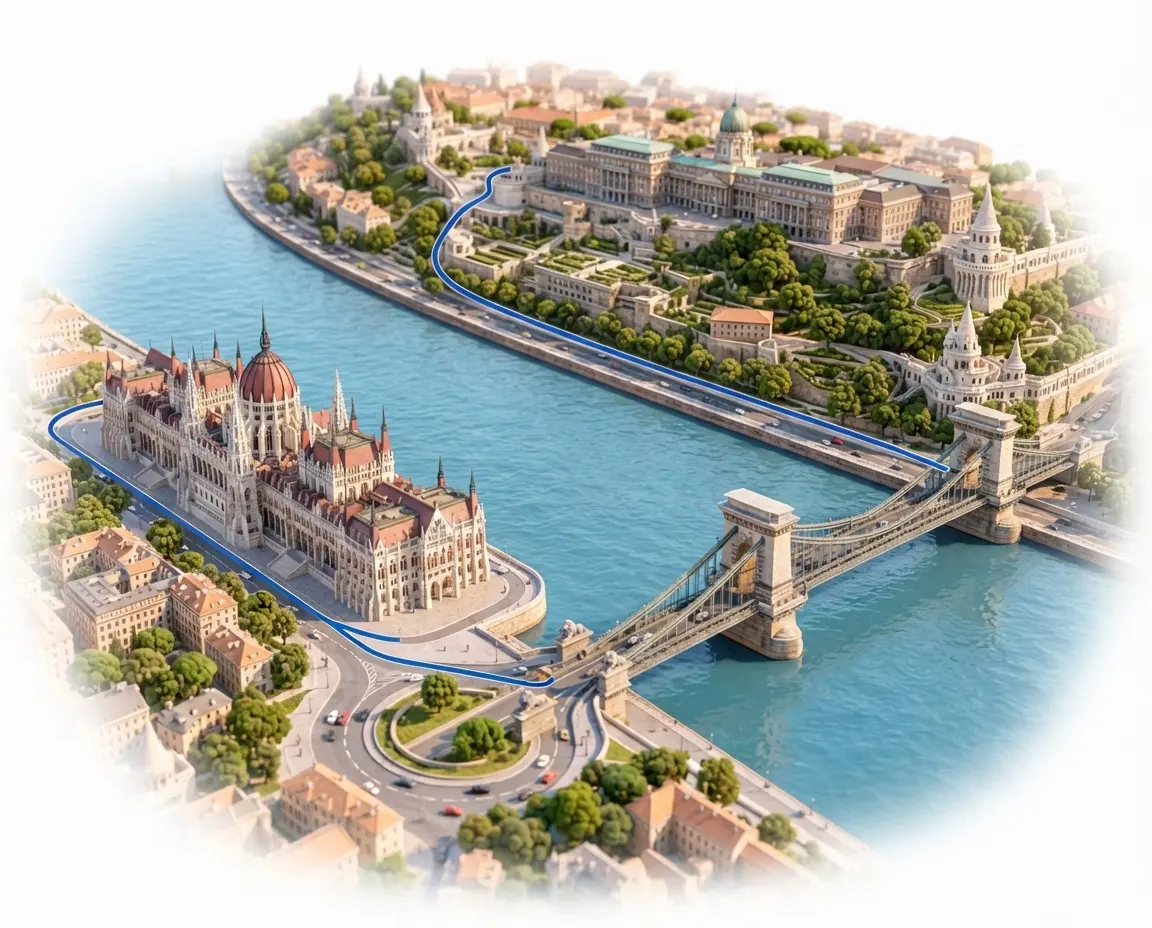
  1. Day 1: Castle Hill · Lipótváros and the ParliamentBuda Castle District → Fisherman's Bastion → Hungarian Parliament Building → St. Stephen's Basilica → Chain Bridge → Heroes' SquareOpen in Google Maps
See the plan
2

2 days in Budapest

9 stops, about 51 min of walking in total.

  1. Day 1: City Park · Lipótváros and the ParliamentSzéchenyi Thermal Bath → Hungarian Parliament Building → Chain BridgeOpen in Google Maps
  2. Day 2: Castle Hill · Lipótváros and the ParliamentFisherman's Bastion → Matthias Church → Buda Castle District → St. Stephen's Basilica → Vajdahunyad Castle → Heroes' SquareOpen in Google Maps
See the plan
3

3 days in Budapest

13 stops, about 1 h 39 of walking in total.

  1. Day 1: City Park · Lipótváros and the ParliamentSzéchenyi Thermal Bath → Hungarian Parliament Building → Chain BridgeOpen in Google Maps
  2. Day 2: Castle Hill · Lipótváros and the ParliamentFisherman's Bastion → Matthias Church → Buda Castle District → St. Stephen's Basilica → Vajdahunyad Castle → Heroes' SquareOpen in Google Maps
  3. Day 3: Inner Pest · Jewish QuarterGreat Market Hall → Dohány Street Synagogue → Hungarian National Museum → Gellért Hill and the CitadellaOpen in Google Maps
See the plan

When to go to Budapest

April, May, June, September and October are the easiest months, with highs between 16 and 26 degrees and shorter queues than in high summer. July and August average 28 degrees, and the terraces and baths fill up. December is busy with Christmas markets, and January and February are cold, with highs of 3 to 6 degrees.

Best months
April to June and September to October
Busiest months
July to August and December

Budapest month by month

Climate averages: HungaroMet.

Budapest by season

Spring

7 to 17 °C · about 7 rainy days a month

Highs rise from 11 degrees in March to 23 in May. May has the most rain days of the year, about eight, and the parks and Margaret Island turn green.

What to wear: Pack layers and a light waterproof jacket.

Summer

16 to 27 °C · about 7 rainy days a month

June to August highs run from 26 to 28 degrees, with warm nights around 15 to 17. Hot spells can push highs above 34 degrees, and there are five to eight rain days a month.

What to wear: Wear light cotton, a hat and shoes that grip on the steep hill streets, and pack a swimsuit for the baths.

Autumn

7 to 16 °C · about 6 rainy days a month

September is still warm at 23 degrees, October cools to 16 and November to 9, with about seven rain days. The light fades early from late October.

What to wear: Bring a jacket, an umbrella and warmer layers from late October.

Winter

-1 to 4 °C · about 6 rainy days a month

Highs sit between 3 and 6 degrees and nights fall below freezing from December to February. There are six or seven wet days a month and the daylight is short, which suits the baths.

What to wear: Wear a warm coat, a hat, gloves and shoes with grip for icy pavements.

If it rains

Rain does not stop a visit to Budapest, because the thermal baths work well in wet weather. The Parliament, the National Museum, the House of Terror, the Basilica, the Synagogue and the Opera are all indoors, and the Great Market Hall is a covered stop. Keep Castle Hill, the bridges and Margaret Island for a dry spell.

Stops under a roof

The rainy-day plan for Budapest

What Budapest costs

Per person, without the hotel. Tickets are the prices of the stops in each plan, read on the official sites. Food and transport come from the city figures.

PlanTicketsTransportFoodTotal
1 day HUF 15,700 HUF 2,750 HUF 10,093 to HUF 16,686 HUF 28,543 to HUF 35,136
2 days HUF 32,300 HUF 5,500 HUF 20,186 to HUF 33,372 HUF 57,986 to HUF 71,172
3 days HUF 35,800 HUF 8,250 HUF 30,279 to HUF 50,058 HUF 74,329 to HUF 94,108

Stops with a ticket whose price we could not confirm are left out of the sum.

  • Meal in an inexpensive restaurantHUF 4,500
  • CoffeeHUF 1,093
  • Single rideHUF 500
  • 24-hour passHUF 2,750

The full budget for Budapest

What to eat in Budapest

Gulyás

A thick beef soup with paprika, potatoes and carrots. It is a lunch dish, and many places serve it in a bowl with bread.

Lángos

Deep fried flatbread, usually topped with sour cream and grated cheese. People eat it as a market or street snack.

Paprikás csirke

Chicken in a creamy paprika sauce, served with small dumplings called nokedli.

Halászlé

A hot, red fish soup made with paprika, traditionally from river fish. It is a classic around the Danube.

Kürtőskalács

Chimney cake, a sweet dough baked around a spit and rolled in sugar. Stalls sell it warm.

Tokaji

A wine from the Tokaj region, best known for its sweet versions. Wine bars pour it by the glass with cheese or dessert.

Dishes and food prices in Budapest

Besides the sights

  1. 1

    An evening on the Danube

    Boats run between the bridges after dark, when the Parliament and Castle Hill are lit. The stretch between Margaret Bridge and Liberty Bridge shows most of the landmarks.

  2. 2

    Ruin bar courtyards

    Old buildings in the Jewish Quarter have been turned into bars with mismatched furniture and big courtyards. Go in the early evening for a seat.

  3. 3

    A second thermal bath

    The older Ottoman era baths on the Buda bank are smaller than Széchenyi and have domes from the 16th century. Check the day schedule, because some baths have separate or mixed days.

  4. 4

    Tram 2 along the embankment

    The line follows the Pest bank of the Danube, with Castle Hill, the bridges and the Parliament in view. It runs on an ordinary ticket.

  5. 5

    Andrássy Avenue on foot

    A long walk from the Opera to Heroes' Square under plane trees, past villas, cafes and embassies. It takes about 40 minutes without stops.

Arriving

Budapest Ferenc Liszt Airport is about 16 kilometres from the centre. The 100E bus runs to Deák Ferenc tér in the middle of Pest in about 40 minutes, and the 200E bus connects to the M3 metro at Kőbánya-Kispest. The main train stations are Keleti, Nyugati and Déli, and all three have metro stations.

Getting around

The centre is walkable, and the metro, trams and buses cover the rest. A single ticket costs HUF 500 and a 24 hour travelcard HUF 2,750, so the pass pays off from the sixth ride. The yellow M1 line runs under Andrássy Avenue to City Park, and tram 2 follows the Pest embankment past the bridges and the Parliament.

Where to stay

  • Inner Pest and LipótvárosClose to the Parliament, the Basilica and the Chain Bridge, with the best metro links, which suits a first visit.
  • Jewish QuarterBusy evenings and the synagogue on the doorstep, so it suits visitors who want to be out late.
  • Castle Hill and VízivárosQuiet at night and close to the views, but with fewer places to eat and a climb or funicular to reach.
  • Andrássy AvenueA tree-lined avenue near the Opera and the House of Terror, well served by the M1 for City Park.

Before you go

  • Buy and validate your transit ticket before boarding, because inspectors check on the metro and trams and a ticket bought on board costs more.
  • Book the Parliament tour before you travel, because entry is by timed slot.
  • Check the day: the Synagogue complex is closed on Saturdays, and the National Museum and the House of Terror are closed on Mondays.
  • Cover shoulders and knees for the Dohány Street Synagogue and the churches, since sleeveless tops and shorts are refused at the synagogue.
  • Fisherman's Bastion sells tickets by card only, so keep a card to hand when you go up to the upper terraces.

The 16 stops in Budapest

Every stop has its own page with opening days, ticket price, how to get there and where it fits in the itineraries.

  • Lipótváros and the Parliament

    Hungarian Parliament Building

    The seat of the National Assembly on the Pest bank of the Danube, built to mark a thousand years of the Hungarian state. A visit is a 45 minute walk through the grand staircase, the Dome Hall and the old upper house chamber.

    • 2 h
    • Open daily
    • HUF 14,000
    Book ahead
  • Castle Hill

    Buda Castle District

    The walled hill above the Danube, with the Royal Palace, Matthias Church and Fisherman's Bastion within a few minutes' walk of each other. The streets are free, and the views over Pest are the main draw.

    • 2 h 30
    • Always open
    • Free
  • Castle Hill

    Fisherman's Bastion

    A terraced lookout with seven towers and white stone arcades, facing the Danube and the Parliament. The lower terraces are free at any hour, and the upper terraces charge during the day.

    • 45 min
    • Always open
    • HUF 1,700
  • City Park

    Széchenyi Thermal Bath

    A large thermal bath in City Park, in a yellow neo-Baroque building with outdoor pools, indoor pools and saunas. A visit is a half day of soaking, with lockers or cabins for changing.

    • 5 h
    • Open daily
    • HUF 13,200
    Booking advised
  • Lipótváros and the Parliament

    St. Stephen's Basilica

    A neo-classical basilica in Pest with a dome you can climb to a panoramic terrace. The church hall, the treasury and the terrace have separate opening times.

    • 1 h 30
    • Open daily
  • Lipótváros and the Parliament

    Chain Bridge

    The first permanent bridge over the Danube in Budapest, opened in 1849, linking Pest with the foot of Castle Hill. Stone lions guard each end, and crossing on foot takes a few minutes.

    • 30 min
    • Always open
    • Free
  • Castle Hill

    Matthias Church

    The Gothic church of Our Lady on Castle Hill, with a patterned tile roof and painted walls inside. A ticket covers the church, and the tower is a separate timed ticket.

    • 1 h
    • Open daily
    • HUF 3,400
  • Inner Pest

    Great Market Hall

    The big covered market on Fővám tér, with vegetable, meat and paprika stalls on the ground floor and food counters and craft stalls upstairs. Entry is free.

    • 1 h 30
    • Open daily
    • Free
  • Jewish Quarter

    Dohány Street Synagogue

    The largest synagogue in Europe, a Moorish Revival building in the Jewish Quarter, with a Jewish museum, a memorial garden and the Heroes' Temple in the same complex. It is closed on Saturdays.

    • 1 h 30
    • Closed Sat
    Booking advised
  • City Park

    Heroes' Square

    A monumental square at the end of Andrássy Avenue, with a 36 metre column topped by the Archangel Gabriel and colonnades of Hungarian rulers. It is open at all hours and free.

    • 40 min
    • Always open
    • Free
  • Gellért Hill

    Gellért Hill and the Citadella

    A steep hill on the Buda bank with the Citadella fortress on top, the Liberty Statue and a wide view of the Danube bridges and Pest. The park paths are free and open at all hours.

    • 2 h
    • Always open
    • Free
  • Andrássy Avenue

    House of Terror Museum

    A museum in a former headquarters of the Arrow Cross and later the communist secret police, on Andrássy Avenue. It covers Hungary under fascist and communist rule through rooms, documents and the basement cells.

    • 2 h
    • Closed Mon
    • HUF 4,000
  • Margaret Island

    Margaret Island

    A green island 2.8 kilometres long in the Danube between Buda and Pest, mostly closed to cars. It has gardens, ruins, running paths and shaded lawns for a slow afternoon.

    • 2 h 30
    • Always open
    • Free
  • Inner Pest

    Hungarian National Museum

    The country's main history museum, in a neoclassical building on Múzeum körút. The permanent exhibitions follow Hungarian history and archaeology, and the collection includes the Seuso Treasure and the Coronation Mantle.

    • 1 h 40
    • Closed Mon
    • HUF 3,500
  • Andrássy Avenue

    Hungarian State Opera House

    A neo-Renaissance opera house on Andrássy Avenue, with marble stairways, gilded halls and an auditorium for about 1,000 people. Without a performance ticket you can see it on a 60 minute guided tour that ends with a short concert.

    • 1 h 20
    • Open daily
    • HUF 12,000
    Booking advised
  • City Park

    Vajdahunyad Castle

    A group of buildings in City Park that copy Hungarian architecture from different periods, beside a lake used for boating in summer and skating in winter. The grounds are free to walk.
    • 45 min
    • Always open
    • Free

Common questions

Is one day in Budapest enough?

One day covers Castle Hill, the Chain Bridge and an evening on the Pest side if you start early. You will miss the Parliament tour and a bath unless you book ahead. Book those two first and fit the rest around them.

Do I need to book the Parliament?

Yes. Entry is by timed tour, with an audio guide or a guide in six languages, and the tour lasts 45 minutes. Book a slot on the Parliament's official ticket site before you travel.

What is closed on Mondays and Saturdays in Budapest?

The National Museum and the House of Terror are closed on Mondays. The Dohány Street Synagogue complex is closed on Saturdays, and Matthias Church closes at 12:15 on Saturdays. Castle Hill, the bridges, the baths and the Great Market Hall are open.

Does a day pass pay off?

A single ticket costs HUF 500 and a 24 hour travelcard costs HUF 2,750, so the pass pays off from the sixth ride. Many days in the centre need fewer rides, because the main sights are close together. Buy the ticket before you board.