One day in Valencia
3 stops, about 9 min of walking in total.
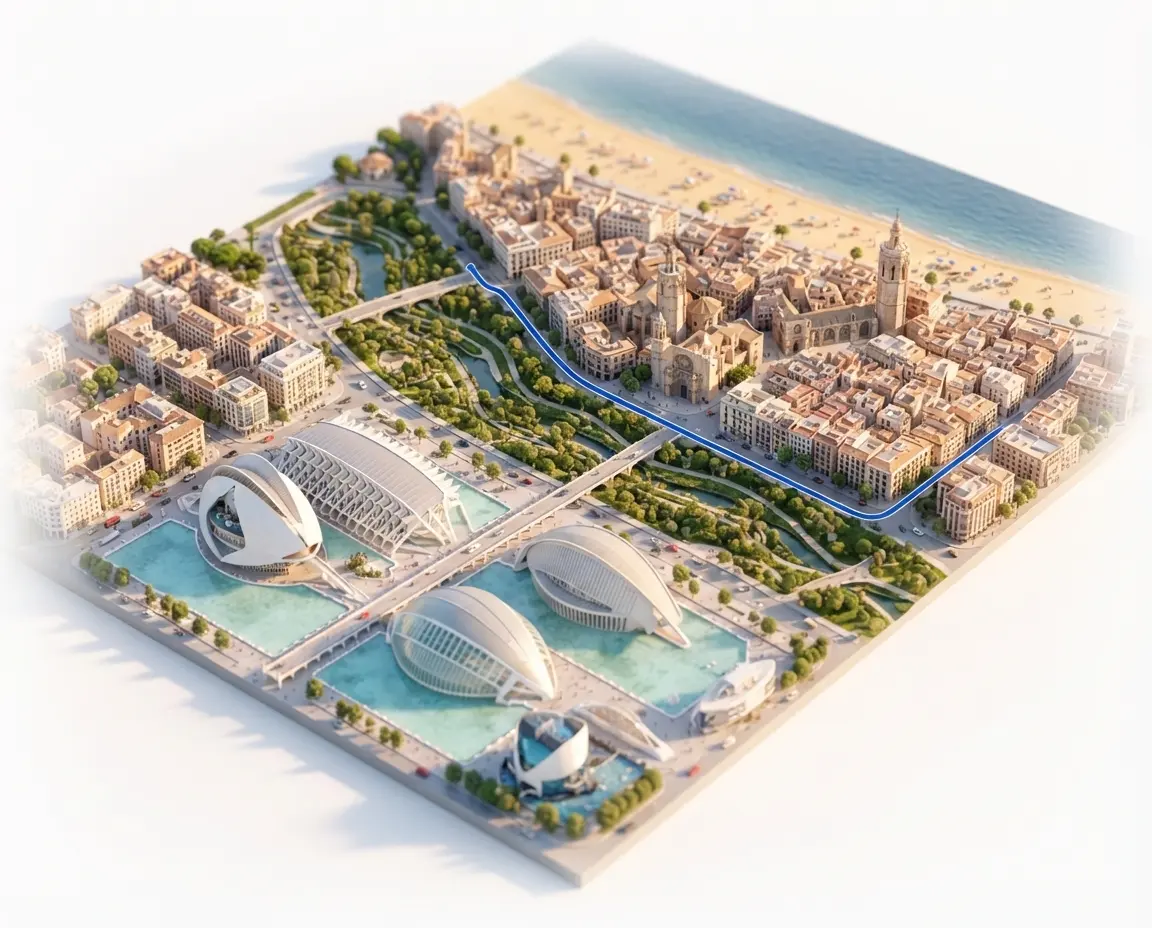
- Day 1: City of Arts and Sciences · Old townCity of Arts and Sciences → Oceanogràfic → Plaza de la VirgenOpen in Google Maps
Spain
Valencia sits on a flat plain by the Mediterranean, with a compact old town in the north and the City of Arts and Sciences at the far end of a long river park. Most of the history fits into a short walk through the old town, while the aquarium, the zoo and the beach need a tram, a bus or a bike. Rice dishes shape the day here, so lunch is part of the plan.
Data checked on October 5, 2026
Each plan is built from the stop base, with visit time, the walk between stops and a lunch break. Open one and set your pace and arrival day.
3 stops, about 9 min of walking in total.
10 stops, about 55 min of walking in total.
14 stops, about 1 h 45 of walking in total.
April, May, June and October give mild to warm days, with highs from about 21 to 27 degrees and lighter crowds. March is busy because of the Fallas festival, and July and August are hot, humid and crowded around the beach. September brings the most rain of the year, in short and heavy downpours.
Climate averages: Agencia Estatal de Meteorología.
12 to 22 °C · about 4 rainy days a month
Highs climb from about 19 degrees in March to 24 in May, with moderate rain. The city is busy for Fallas in mid March, then calmer in April and May.
What to wear: Light layers, a jacket for the evenings and shoes made for old cobbled streets.
21 to 29 °C · about 2 rainy days a month
Highs run from about 27 to 31 degrees between June and August, and nights stay close to 20 degrees or above. The beach is full, and the hours from 13:00 to 17:00 are the hardest for sightseeing.
What to wear: Light cotton, a hat, sunglasses, sandals and swimwear, plus a thin layer for cool museums.
15 to 24 °C · about 5 rainy days a month
September is still hot at about 28 degrees, then highs ease to about 25 in October and 20 in November. Autumn has the heaviest rain of the year, often in short and hard downpours.
What to wear: Layers and a compact umbrella. Swimwear still works in September and early October.
8 to 17 °C · about 4 rainy days a month
Days are mild and often sunny, with highs around 17 degrees and lows around 7 or 8. Crowds are the lightest of the year.
What to wear: A medium jacket and a scarf for the evenings, and a light waterproof layer for the few rainy days.
Valencia has few rainy days, but when it rains the downpour can be heavy, mostly in September and October. Switch to the Mercado Central, the Lonja, the cathedral, the ceramics museum and the free Museu de Belles Arts. The gate towers can limit visits in rain, and the Oceanogràfic and the Bioparc are mostly outdoors.
Stops under a roof
The summer sun is strong, with highs near 30 degrees in July and August. Plan outdoor sights for the morning and the last hours of daylight, and keep the cathedral, the market or a museum for 13:00 to 17:00. Shade is scarce in the Turia gardens and on the beach, so carry water and sunscreen.
Better outdoors
Per person, without the hotel. Tickets are the prices of the stops in each plan, read on the official sites. Food and transport come from the city figures.
| Plan | Tickets | Transport | Food | Total |
|---|---|---|---|---|
| 1 day | €0 | €8 | €36 to €52 | €44 to €60 |
| 2 days | €12 | €16 | €73 to €104 | €101 to €132 |
| 3 days | €15 | €24 | €109 to €155 | €148 to €194 |
Stops with a ticket whose price we could not confirm are left out of the sum.
Rice cooked in a wide pan with chicken, rabbit, flat green beans and white beans, traditionally over a wood fire. It is a lunch dish, served from around 14:00, and it is cooked to order, so expect a wait.
Rice cooked in fish stock and served with a spoonful of garlic mayonnaise. A good choice if you want rice without meat.
A paella made with short noodles instead of rice, usually with seafood. It is a dish of the Valencian coast.
A cold, sweet drink made from tiger nuts, served with a soft, sugar-dusted pastry for dipping. People have it in the afternoon, and the tiger nuts are grown near the city.
A mid-morning filled roll with a small drink, a local habit around 10:30 or 11:00. Many bars sell a set of roll and coffee or a small beer.
A cold mix of cava, orange juice and spirits, made with the local oranges. It is stronger than it tastes, so share a jug.
Ride the old riverbed on a flat path from the Bioparc end to the City of Arts and Sciences, stopping at the bridges and playgrounds on the way. Rent a bike for a few hours and ride early or late in summer.
Cabanyal is the old fishermen's quarter by the beach, known for its low streets and tiled house fronts. Walk from the tram stop toward the sea in the late afternoon.
During the Fallas festival a loud daytime firework display called the mascletà goes off in the central square at 14:00. Stand at the edge of the crowd and bring ear protection.
Buy fruit and cured meats at a market in Ruzafa, then eat standing at a bar counter. Local shoppers go before midday.
The glass concert hall beside the Turia gardens hosts symphonic and chamber music through the year. Check the programme for dates.
From Valencia airport the Metrovalencia metro reaches the centre in about 25 minutes, and a taxi takes about 20. Regional trains arrive at the Estación del Nord, next to the Xàtiva metro stop and a short walk from the old town. High-speed trains use Joaquín Sorolla station, a few kilometres south, with metro, bus and taxi links into the centre.
The old town is small enough to walk, and the Lonja, the Mercado Central and the cathedral sit within about ten minutes of each other. Use the metro or tram for the Oceanogràfic, the beach and the airport, and a bike for the flat Turia gardens. A short stay rarely adds up to many rides, so single tickets are enough for most visitors.
Every stop has its own page with opening days, ticket price, how to get there and where it fits in the itineraries.
City of Arts and Sciences
A group of white, futuristic buildings set among pools at the end of the Turia gardens. You can walk around the outside for free, while the science museum, the planetarium and the aquarium each charge their own admission.
City of Arts and Sciences
A large aquarium laid out as separate pavilions, each for a different marine habitat, with an underwater tunnel and a dolphin show. Most of the route is walked outdoors between the buildings.
Booking advisedOld town
A cathedral begun in the 13th century that mixes Gothic, Romanesque, Renaissance and Baroque parts. The cultural visit includes the museum and an audio guide, and the Miguelete bell tower is a separate ticket.
Old town
The Gothic silk exchange of Valencia, a UNESCO World Heritage site. The columned trading hall is the main reason to go in, and the visit is short.
Old town
A large covered food market in an early 20th century modernist hall. Stalls sell fish, meat, fruit, vegetables, rice and cured goods.
Turia gardens
A long park in the dry bed of the old river Turia, with paths, sports fields and playgrounds from the Bioparc to the City of Arts and Sciences. It is the easiest way to cross the city on foot or by bike.
El Carmen and the gates
The oldest part of the old town, a maze of narrow streets, small squares and street murals. It is quiet in the morning and busy after dark.
El Carmen and the gates
A Gothic city gate with two towers and a stair up to a roof terrace. The top gives a view over the old town and the Turia gardens.
Old town
The central square of the old town, set between the cathedral and the baroque basilica of the Virgen de los Desamparados, with a fountain in the middle.
Old town
A museum of ceramics and decorative arts inside the Palacio del Marqués de Dos Aguas, known for its carved alabaster doorway. The rooms run from Valencian tiles to Chinese porcelain.
Beach
The best-known urban beach of Valencia, a wide strip of sand with a promenade and seafront restaurants. It runs north from the Las Arenas hotel.
El Carmen and the gates
A 15th century Gothic city gate with two round towers, still pitted by cannon fire from the early 19th century. A stone stair leads to a roof terrace.
Turia gardens
A large art museum with Valencian painting, Spanish masters and a room for Joaquín Sorolla, free to enter. It stands beside the Turia gardens.
Ruzafa
A grid of low streets south of the old town with cafés, small galleries and a covered market. It is a place to eat and walk more than a place for sights.
Turia gardens
A zoo where the animals live in landscaped African habitats with few visible fences. It sits at the western end of the Turia gardens.
Booking advisedOne day covers the old town: the Lonja, the Mercado Central, the cathedral and the squares, which sit within about ten minutes of each other. The City of Arts and Sciences and the Oceanogràfic need a separate half day, so a short stay means choosing between the old town and the south-east. Add the Turia gardens and the beach if you have more time.
April, May, June and October have mild to warm weather and fewer crowds than the summer months. March is busy because of the Fallas festival, and July and August are hot and crowded at the beach.
You can buy a ticket at the ticket office, but the official site advises booking online on weekends, public holidays and in high season. The price depends on the date, and the ticket office closes one hour before the park.
Use the covered places: the Mercado Central, the Lonja, the cathedral, the ceramics museum and the free Museu de Belles Arts. The gate towers can close in rain, and the Oceanogràfic is mostly walked outdoors between pavilions.