One day in Dublin
4 stops, about 1 h 01 of walking in total.
- Day 1: Trinity and College Green · Medieval DublinTrinity College and the Book of Kells → Dublin Castle → Guinness Storehouse → Temple BarOpen in Google Maps
Ireland
Dublin is a compact city on the River Liffey, with most of its sights within a short walk of Trinity College and Dublin Castle. Medieval cathedrals, Georgian squares and free national museums sit close together, while the Guinness Storehouse and Kilmainham Gaol lie a tram ride to the west. The weather changes by the hour, so the plan works best when it can swap an outdoor stop for an indoor one.
Data checked on October 5, 2026
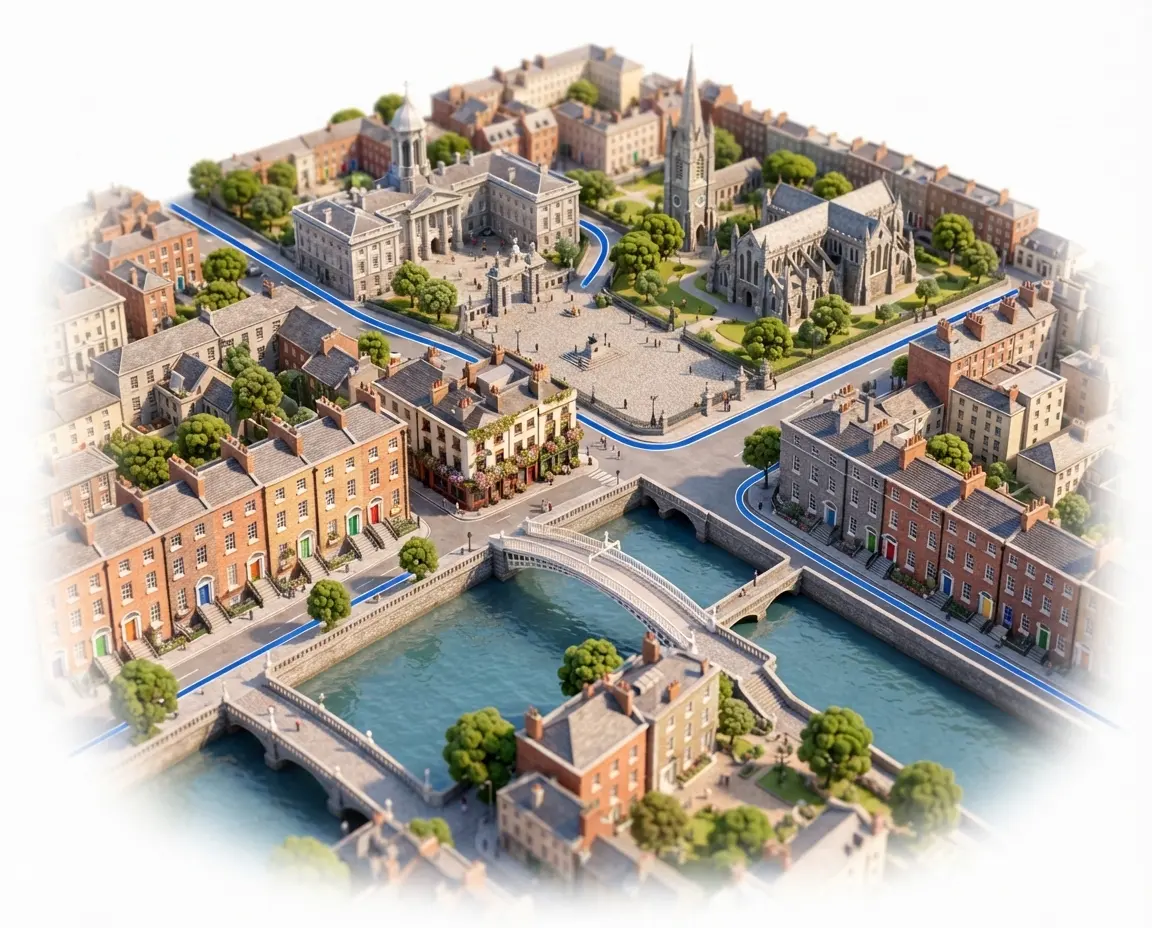
Each plan is built from the stop base, with visit time, the walk between stops and a lunch break. Open one and set your pace and arrival day.
4 stops, about 1 h 01 of walking in total.
9 stops, about 51 min of walking in total.
12 stops, about 1 h 03 of walking in total.
April, May and September are the best months, with highs of 13 to 17 degrees and the queues thinner than in summer. June to August is the warmest and the busiest, with highs near 20 degrees. From November to February it rains on 10 to 12 days a month and the days are short.
Climate averages: Met Éireann.
7 to 13 °C · about 10 rainy days a month
Highs of 11 to 15 degrees and about 9 to 10 rainy days a month. The parks come into leaf, and queues are moderate until Easter and around St Patrick's Day on 17 March.
What to wear: A waterproof jacket, layers and comfortable shoes for wet pavements.
13 to 19 °C · about 10 rainy days a month
Highs of 18 to 20 degrees and lows of 12 to 14. Daylight lasts late into the evening and the streets are at their busiest.
What to wear: Light layers, a rain jacket and sun cream for clear days.
9 to 14 °C · about 11 rainy days a month
September is mild with highs of 17 degrees. From October the rain returns, with 11 to 12 rainy days a month in October and November.
What to wear: A warm layer, a waterproof coat and shoes that cope with wet leaves.
4 to 9 °C · about 11 rainy days a month
Highs of 9 degrees and lows of 4, with 10 to 12 rainy days a month. Daylight is short, and some attractions close on 24 to 26 December.
What to wear: A warm waterproof coat, a hat and gloves, and shoes with grip.
Rain falls on 9 to 12 days in every month, so a plan needs an indoor option. The National Museum, the National Gallery, the Irish Museum of Modern Art, EPIC, the cathedrals and the Guinness Storehouse all work in the rain, and the museums are free. Showers pass quickly, so a light waterproof is more useful than an umbrella in the wind.
Stops under a roof
Dublin rarely gets hot, and the average high peaks around 20 degrees in July. On a clear day save the open stops such as Phoenix Park, Merrion Square and the Green, and keep the museums for cloudy hours. Daylight runs late in June, so evening walks along the river are possible well after dinner.
Better outdoors
Per person, without the hotel. Tickets are the prices of the stops in each plan, read on the official sites. Food and transport come from the city figures.
| Plan | Tickets | Transport | Food | Total |
|---|---|---|---|---|
| 1 day | €59 | €6 | €46 to €75 | €111 to €140 |
| 2 days | €90.50 | €12 | €93 to €150 | €195 to €252 |
| 3 days | €108.50 | €18 | €139 to €224 | €266 to €351 |
A plate of fried eggs, sausage, bacon, black and white pudding, tomato and toast. Cafes and hotels serve it until late morning.
A slow-cooked stew of lamb or mutton with potato, carrot and onion. Pubs serve it in autumn and winter.
A creamy soup of fish and shellfish, usually served with brown soda bread. It is a standard order on a cold, wet day.
A potato pancake from the north-west of Ireland, filled or served with meat, fish or vegetables. Some restaurants in the centre serve it as a main dish.
A dark, creamy drink poured slowly in two stages in a pub. Ask for it at the bar and wait for the settle before it is topped up.
Hot coffee with whiskey and sugar, topped with lightly whipped cream. It suits an evening after rain.
Sessions run most evenings in the pubs around Temple Bar and across the river. Arrive early for a seat and order at the bar.
A DART train from the centre takes about 30 minutes to the fishing harbour, and a path loops around the headland above the sea.
Start at the Ha'penny Bridge and walk east past the quays to the Samuel Beckett Bridge. It is free and best after the evening light turns warm.
Take the DART south for a walk along the pier and the sea at Sandycove. Some people swim at the Forty Foot, even in cold weather.
In summer and early autumn the big hurling and Gaelic football matches take place at the stadium north of the centre. The stadium also runs visitor tours.
From Dublin Airport, express and city buses reach the centre in roughly 30 to 50 minutes depending on traffic, and a taxi takes a similar time outside rush hour. Trains from the rest of Ireland arrive at Heuston, on the Luas Red line, or at Connolly, about ten minutes on foot from O'Connell Street.
The centre is best on foot. Use the Luas Red line for Kilmainham and the Storehouse, the Luas Green line for the Green and Trinity, and the DART for the coast. A TFI Leap Card caps daily travel at 6 euros, so it pays off from about three separate journeys in a day.
Every stop has its own page with opening days, ticket price, how to get there and where it fits in the itineraries.
Trinity and College Green
The oldest university in Ireland holds the Book of Kells and the Long Room of the Old Library. The visit is timed, runs through an exhibition and the Old Library, and ends in a shop.
Book aheadThe Liberties
A self-guided tour through seven floors on how stout is made and sold, ending with a pint in the Gravity Bar at the top of the building. Allow a full morning or afternoon.
Booking advisedKilmainham and Phoenix Park
A Victorian prison where the leaders of the 1916 Rising were held and executed. Entry is by guided tour only, followed by time in the museum.
Book aheadMedieval Dublin
A working government complex with the State Apartments, once the seat of British rule and today used for state occasions. You can tour the rooms alone or with a guide.
Booking advisedThe Liberties
The national cathedral of the Church of Ireland and the largest church in the country, with Jonathan Swift buried inside. Sunday visiting windows are short.
Medieval Dublin
The medieval cathedral of Dublin, with a large crypt and a self-guided visit with an audio guide. It sits a short walk uphill from the river.
Georgian Dublin
The national collection of Irish gold, Celtic metalwork and Viking finds, in a domed building on Kildare Street. Entry is free.
Georgian Dublin
Irish and European painting from about 1300 to the present, with works by Vermeer, Caravaggio and Jack B Yeats. The permanent collection is free.
Temple Bar
A cobbled quarter of narrow streets, pubs and small galleries between Dame Street and the river. It is livelier after dark and quiet and cheaper by day.
Georgian Dublin
A Victorian park in the middle of the city, with a pond, a bandstand and shaded paths. It suits a break between museums.
Docklands
An interactive museum in the old vaults at the docks about the Irish who left and what they did abroad. It is a good rainy-day stop.
Booking advisedKilmainham and Phoenix Park
One of the largest enclosed city parks in Europe, with a herd of fallow deer, a walled garden and long paths. It needs half a day if you go beyond the main gate.
Georgian Dublin
The best preserved Georgian square in the city, with brightly painted doors, a park in the middle and an Oscar Wilde statue. Allow a short stop between museums.
Georgian Dublin
A small museum in a Georgian house on St Stephen's Green, told through donated objects and a guided tour. It covers Dublin in the 20th century.
Booking advisedKilmainham and Phoenix Park
Modern and contemporary art in the Royal Hospital Kilmainham, a 17th century building with formal gardens. Entry is free and it pairs with Kilmainham Gaol.
One day covers Trinity College, Dublin Castle and a cathedral, with a walk through Temple Bar and the Green. You will miss Kilmainham Gaol and the Guinness Storehouse unless you book both early and move fast. Book the Book of Kells first, because it is the timed ticket that sells out.
Book the Book of Kells at Trinity and Kilmainham Gaol, which only runs guided tours and releases tickets 28 days ahead. The Guinness Storehouse, Dublin Castle, EPIC and the Little Museum are best booked too. The cathedrals, the free museums and the parks take walk-ups.
Monday closes the Irish Museum of Modern Art, and the National Gallery opens at 11:00 on Mondays and Sundays. On Sundays the cathedrals open only for short windows, such as St Patrick's from 9:00 to 10:30, 13:00 to 14:30 and 16:30 to 18:00.
The centre is walkable. For the western sights, use the Luas Red line, which stops near Kilmainham and the Storehouse, and use buses or the DART for the rest. A TFI Leap Card caps daily travel at 6 euros across Dublin Bus, Luas, DART and commuter rail, and you must tap on and off at each stop.