One day in Cordoba
4 stops, about 24 min of walking in total.
- Day 1: Alcázar and Campo Santo de los Mártires · Mezquita and the riverAlcázar de los Reyes Cristianos → Mezquita-Catedral → Judería → Plaza de la CorrederaOpen in Google Maps
Spain
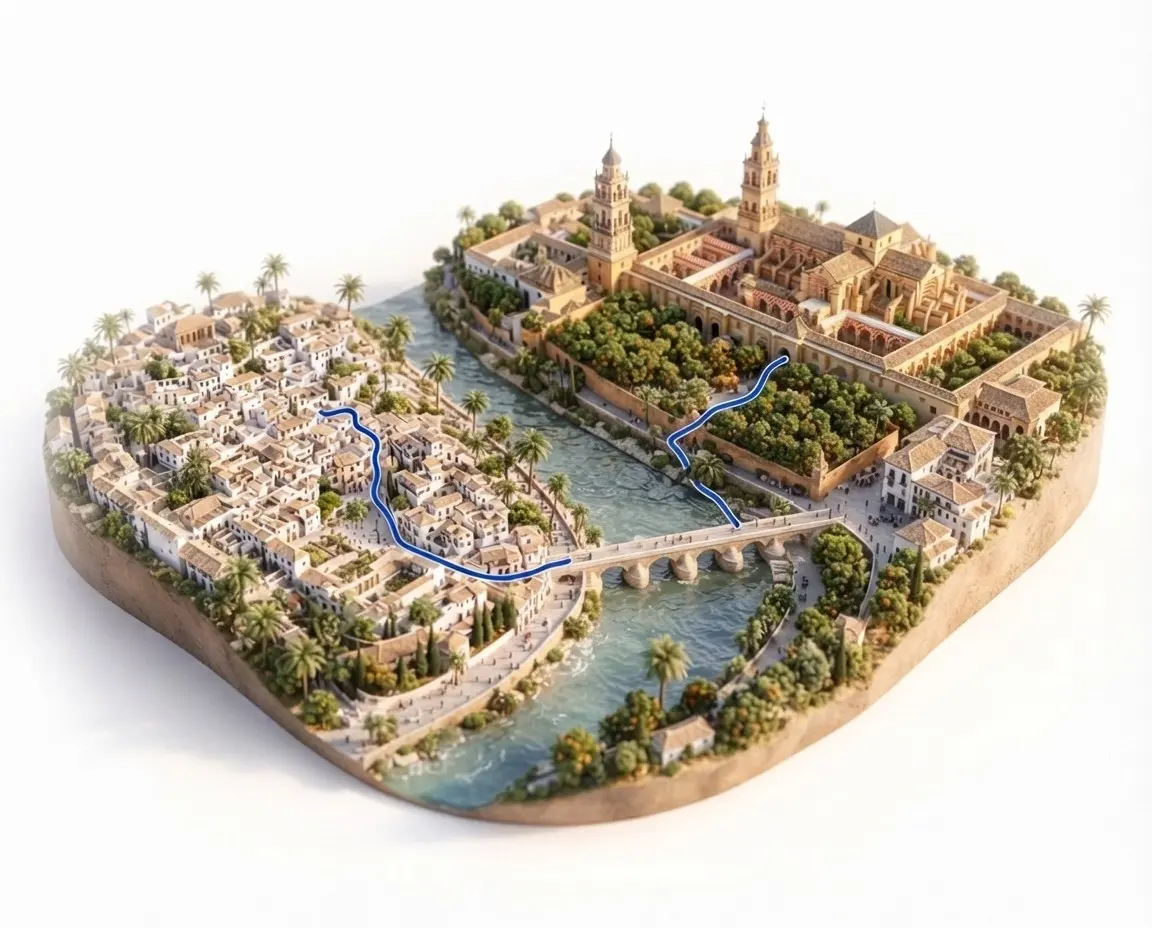
Córdoba sits on the Guadalquivir, with the Mezquita-Catedral at the heart of a small, flat old town. The Judería, the Alcázar and the Roman Bridge are all a short walk apart. Medina Azahara, the ruined caliphal city, lies 8 km west and needs a trip of its own.
Data checked on November 2, 2026
Each plan is built from the stop base, with visit time, the walk between stops and a lunch break. Open one and set your pace and arrival day.
4 stops, about 24 min of walking in total.
11 stops, about 1 h 19 of walking in total.
14 stops, about 1 h 34 of walking in total.
March to May and October are the best months, with highs between about 21 and 28 degrees. April and May are also the busiest because the patios are in flower. July and August are the hottest, with highs around 37 degrees and almost no rain, and winter days are mild but wet from October to January.
Climate averages: Agencia Estatal de Meteorología.
10 to 24 °C · about 6 rainy days a month
Highs rise from about 21 degrees in March to 28 in May, with six or so rain days in March and April. The patios and gardens are at their best and the old town is busy.
What to wear: Bring layers and a light rain jacket, since mornings are cool and afternoons get warm.
19 to 36 °C · about 1 rainy days a month
Highs reach 33 degrees in June and about 37 in July and August, with almost no rain. Municipal museums and the Alcázar close at 14:15 in summer, so see them in the morning.
What to wear: Wear light cotton, a hat and comfortable sandals, and carry water.
13 to 26 °C · about 5 rainy days a month
September is still hot at about 32 degrees, October settles near 26 and November near 19. Rain returns, with six or seven rain days a month from October.
What to wear: Bring a light jacket for the evenings and a waterproof layer from October.
5 to 16 °C · about 7 rainy days a month
Days reach about 15 to 17 degrees and nights fall to 4 or 5. It rains on six or seven days in December and January, but queues are short.
What to wear: Wear a warm coat and shoes with grip, since wet stone can be slippery.
A wet day is easy to fill: the Mezquita, the Archaeological Museum, the Julio Romero de Torres Museum, the Caliphal Baths, the Calahorra Tower and Mercado Victoria are all indoors. The Judería lanes and the patios are best kept for dry weather, and Medina Azahara is mostly outdoors.
Stops under a roof
From June to September the afternoons are very hot, so do the outdoor sights early or after about 18:00. Medina Azahara opens in the evening in summer, which suits the heat. The Mezquita and the museums give cool breaks in the middle of the day.
Better outdoors
Per person, without the hotel. Tickets are the prices of the stops in each plan, read on the official sites. Food and transport come from the city figures.
| Plan | Tickets | Transport | Food | Total |
|---|---|---|---|---|
| 1 day | €22 | €5 | €26 to €42 | €53 to €69 |
| 2 days | €25 | €10 | €53 to €83 | €88 to €118 |
| 3 days | €36 | €15 | €79 to €125 | €130 to €176 |
Stops with a ticket whose price we could not confirm are left out of the sum.
A cold, thick tomato and bread soup, usually topped with ham and egg. It is the local dish to order in warm weather.
Oxtail stewed slowly in wine and vegetables until it falls off the bone. A classic main course in winter.
A roll of ham wrapped in pork loin, breaded and fried. Often shared as a starter or a tapa.
Thin slices of aubergine fried and drizzled with cane honey. A popular tapa in the bars.
A pastry filled with sweet pumpkin preserve, usually eaten with coffee or as a gift to take home.
Dry fino and other wines from the area south of the city, served cold with tapas.
Follow the Guadalquivir from the Roman Bridge towards the Alcázar and watch the Mezquita light up.
Small venues in the old town stage evening shows with dance and guitar, usually booked ahead.
Several bathhouses in the old town offer a relaxing session in the style of the historic baths.
An evening show of Andalusian horses in the Caballerizas Reales, next to the Alcázar.
Local neighbourhood bars away from the Mezquita, where a drink usually comes with a small plate.
Most visitors arrive by train, because Córdoba is on the high-speed line between Madrid and Seville and there are trains to Málaga too. Seville and Málaga airports are the usual gateways. The station is about 1.5 km from the Mezquita, so you can walk, take a bus or a taxi.
The old town is best on foot. Buses run to Medina Azahara and the outer districts, and a single ticket costs 1.30 euros. The 24-hour tourist card costs 5 euros and the 72-hour card 10 euros, which pays off only if you ride several times.
Every stop has its own page with opening days, ticket price, how to get there and where it fits in the itineraries.
Mezquita and the river
A mosque begun in the 8th century and later turned into a cathedral, known for its forest of red and white arches. The visit runs from the courtyard of orange trees through the columned hall and the mihrab to the cathedral nave built inside.
Booking advisedAlcázar and Campo Santo de los Mártires
A fortress-palace by the river, where the Catholic Monarchs lived for eight years. It has towers you can climb, a hall of Roman mosaics and gardens with ponds.
Judería
The old Jewish quarter west of the Mezquita, a web of whitewashed lanes, small squares and flower-filled patios. It is free, has no fixed route and is the best way to walk around the Mezquita.
Medina Azahara
The excavated palace-city of the caliphs, 8 km west of Córdoba and a UNESCO World Heritage Site since 2018. The visit starts at a museum, then a shuttle bus takes you up to the ruins.
Booking advisedMezquita and the river
A long stone bridge with 16 arches over the Guadalquivir, linking the Mezquita side of the city with the Calahorra Tower. It is always open and free, and it is at its best at sunset.
Centro, Corredera and Victoria
A noble house with a series of patios and a garden, plus furnished rooms with tapestries and paintings. It is the easiest place to see Córdoba's patios outside the spring festival.
Judería
A narrow lane near the Mezquita with flower pots on whitewashed walls, ending in a small square with a view of the bell tower. The nearby patios are the heart of Córdoba's patio tradition.
Centro, Corredera and Victoria
A museum in a Renaissance palace, covering Córdoba from prehistory through the Roman and Islamic periods. It is a good rainy-day stop and has pieces from Medina Azahara.
Centro, Corredera and Victoria
A large rectangular Baroque square surrounded by arcaded houses, now full of cafés and bars. It is a good place for a drink or a tapa after the main sights.
Judería
A small medieval synagogue in the Judería, one of the few that survive in Spain. The plasterwork walls are the reason to go, and entry is free.
Alcázar and Campo Santo de los Mártires
The restored baths of the old caliphal palace, with vaulted rooms lit by star-shaped skylights. It is a small, quiet visit next to the Alcázar.
Centro, Corredera and Victoria
A museum devoted to the Córdoba painter Julio Romero de Torres, with six rooms of his portraits and scenes of Andalusian life. It is indoors and suits a short visit on a hot or wet day.
Centro, Corredera and Victoria
A food hall in a late 19th-century industrial building in the Victoria gardens, with more than 20 stalls and a bar. It is a casual place for lunch or dinner with local and international food.
Judería
A small Mudéjar funerary chapel from the end of the 14th century, known for its tilework and plaster decoration. It stands inside a university building in the Judería.
Mezquita and the river
A fortified tower at the south end of the Roman Bridge that houses the Museo Vivo de al-Andalus. The terrace has a wide view of the old town and the Mezquita.
Wi-Fi in hotels, cafés and airports is shared with other guests. A VPN encrypts the connection between your phone or laptop and the VPN's server, which helps when you check email or your bank on the road.
See NordVPNOne day covers the Mezquita, the Judería and the Roman Bridge, with the Alcázar if you start early. Medina Azahara is a separate trip of about three hours on site, plus travel, so it needs a second day or a very early start. Check the opening days first, because many museums close on Mondays.
Tickets are sold online and at the reception centre in the Patio de San Eulogio, so booking ahead is a convenience rather than a rule. A guided visit has a fixed time. There is also a free visit from 8:30 to 9:30, Monday to Saturday, with entry until 9:20.
It is 8 km west of the city. A municipal tourist bus leaves Paseo de la Victoria twice a day, Tuesday to Sunday, and you can also go by taxi, car or a guided tour with transport. On site, a shuttle bus runs between the museum and the ruins.
Yes. The old town is flat and compact, and most sights are within 10 to 15 minutes of the Mezquita on foot. A single bus ticket costs 1.30 euros, and a 24-hour tourist card costs 5 euros, which only pays off if you take several rides.